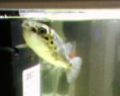
I lost my favorite puffer a couple of days ago. He didn't have an appetite for a day before he passed. I changed the water and cleaned the tank, and even took my surviving one to my fish store where they treated him with meds and tested my water. They said that since my tank is newer (two months) that it is still cycling and my puffer died of shock. He said my other should survive if he can make it through the final Nitrate cycle which should end in about a week.
My concern is that my puffer is surviving so far, but he is hiding behind the filter in a "sleep state" most of the time for the past four days. I'm worried about him, is there anything else I should be doing aside from watching overfeeding him and keeping the light off?
Sick puffer in a newer tank
Forum rules
Read this before posting!!
Since this board has been up, we have found there are several questions that routinely get asked in order to help diagnose problems. If you can have that information to begin with in your post, we'll be able to help right away (if we can!) without having to wait for you to post the info we need.
1) Your water parameters - pH, Ammonia, Nitrite, Nitrates and salinity (if appropriate). This is by far the most important information you can provide! Do not answer this with "Fine" "Perfect" "ok", that tells us nothing. We need hard numbers.
2) Tank size and a list of ALL inhabitants. Include algae eaters, plecos, everything. We need to know what you have and how big the tank is.
3) Feeding, water change schedule and a list of all products you are using or have added to the tank (examples: Cycle, Amquel, salt, etc)
4) What changes you've made in the tank in the last week or so. Sometimes its the little things that make all the difference.
5) How long the aquarium has been set up, and how did you cycle it? If you don't know what cycling is read this: Fishless Cycling Article and familiarize yourself with all the information. Yes. All of it.
We want to help, and providing this information will go a LONG way to getting a diagnosis and hopeful cure that much faster.
While you wait for assistance:
One of the easiest and best ways to help your fish feel better is clean water! If you are already on a regular water change schedule (50% weekly is recommended) a good step to making your fish more comfortable while waiting for diagnosis/suggestions is to do a large water change immediately. Feel free to repeat daily or as often as you can, clean water is always a good thing! Use of Amquel or Prime as a dechlor may help with any ammonia or nitrite issues, and is highly recommended.
Note - if you do not normally do large water changes, doing a sudden, large water change could shock your fish by suddenly changing their established water chemistry. Clean water is still your first goal, so in this case, do several smaller (10%) water changes over the next day or two before starting any large ones.
Read this before posting!!
Since this board has been up, we have found there are several questions that routinely get asked in order to help diagnose problems. If you can have that information to begin with in your post, we'll be able to help right away (if we can!) without having to wait for you to post the info we need.
1) Your water parameters - pH, Ammonia, Nitrite, Nitrates and salinity (if appropriate). This is by far the most important information you can provide! Do not answer this with "Fine" "Perfect" "ok", that tells us nothing. We need hard numbers.
2) Tank size and a list of ALL inhabitants. Include algae eaters, plecos, everything. We need to know what you have and how big the tank is.
3) Feeding, water change schedule and a list of all products you are using or have added to the tank (examples: Cycle, Amquel, salt, etc)
4) What changes you've made in the tank in the last week or so. Sometimes its the little things that make all the difference.
5) How long the aquarium has been set up, and how did you cycle it? If you don't know what cycling is read this: Fishless Cycling Article and familiarize yourself with all the information. Yes. All of it.
We want to help, and providing this information will go a LONG way to getting a diagnosis and hopeful cure that much faster.
While you wait for assistance:
One of the easiest and best ways to help your fish feel better is clean water! If you are already on a regular water change schedule (50% weekly is recommended) a good step to making your fish more comfortable while waiting for diagnosis/suggestions is to do a large water change immediately. Feel free to repeat daily or as often as you can, clean water is always a good thing! Use of Amquel or Prime as a dechlor may help with any ammonia or nitrite issues, and is highly recommended.
Note - if you do not normally do large water changes, doing a sudden, large water change could shock your fish by suddenly changing their established water chemistry. Clean water is still your first goal, so in this case, do several smaller (10%) water changes over the next day or two before starting any large ones.
-
messy_da_legend

- Figure 8 Puffer
- Posts: 223
- Joined: Sat Feb 25, 2006 4:53 pm
- My Puffers: M. baileyi called Esau
- Location: Ipswich UK
I have to admit I'm new to this, but I am trying to learn as quickly as I can- I don't want to lose another one.
I changed the water, and scrubbed the tank- but did not use any chemicals (I didn't know which ones are safe?)
The nitrate was extremely high, but all of the others looked within normal range, also I the saline level was a little low.
I changed the water, and scrubbed the tank- but did not use any chemicals (I didn't know which ones are safe?)
The nitrate was extremely high, but all of the others looked within normal range, also I the saline level was a little low.
-
messy_da_legend
- Figure 8 Puffer
- Posts: 223
- Joined: Sat Feb 25, 2006 4:53 pm
- My Puffers: M. baileyi called Esau
- Location: Ipswich UK
Ok, when you change the water, you should be using a dechlorinator, which removes chlorines and chloramines from your tapwater.
With the filter, the media can be washed in old tank water to prevent killing your good nitrifying bacteria which convert fish waste (ammonia) to nitrite and then nitrate. Your water changes should then remove this nitrate.
With the filter, the media can be washed in old tank water to prevent killing your good nitrifying bacteria which convert fish waste (ammonia) to nitrite and then nitrate. Your water changes should then remove this nitrate.
Tom
1 x M. baileyi
1 x M. baileyi
I don't use dechlorinator. I think its an unnecessary expense. instead I will let my water sit out in buckets for at-least a day before I do my water changes. with This Wait the chlorine is supposed to evaporate.
To eliminate excessive nitrates do frequent water changes.
It is recommended to change 50% once a week.
To eliminate excessive nitrates do frequent water changes.
It is recommended to change 50% once a week.
What's the difference between a fish and a piano?
You can't tuna fish!
You can't tuna fish!
-
messy_da_legend
- Figure 8 Puffer
- Posts: 223
- Joined: Sat Feb 25, 2006 4:53 pm
- My Puffers: M. baileyi called Esau
- Location: Ipswich UK
-
Pufferpunk

- Queen Admin
- Posts: 32987
- Joined: Tue May 31, 2005 11:06 am
- Gender: Female
- My Puffers: Puffers I have kept:
T lineatus
T miurus
A modestus
T biocellatus
C valentini
C coranata
C papuan
C lorteti
DPs
suvattii
burrfish
T niphobles - Location (country): USA, Greenville, SC
- Location: Greenville, SC
- Contact:
all of the others looked within normal rangeCode: Select all
There is no "normal range" for ammonia & nitrates.  They must be 0 at all times.  What's your pH?  What kind of puffer, in what sized tank?

Read the articles on New Tank Syndrome & Fishless Cycling, in our Library.
You are getting sleepy... you only hear the sound of my voice... you must do water changes... water changes... water changes... water changes...
"The solution to pollution is dilution!"
"The solution to pollution is dilution!"
-
Apocalyptictoast
- Dwarf Puffer
- Posts: 80
- Joined: Sat Jun 03, 2006 10:36 pm
- Location: Houston
-
Boxermom

- Former Staff Member
- Posts: 2182
- Joined: Sun Mar 12, 2006 8:34 pm
- Location: Wisconsin
- Contact:
Any idea what kind of puffer it is? And what size tank is he in, and does he have any tankmates?
Tina
Puffers: Auriglobus silus x1, Tetraodon travancoricus x1, Tetraodon turgidus x1, Tetraodon miurus x1, Tetraodon nigroviridis x2, Tetraodon baileyi x2, Tetraodon lineatus x1, Tetraodon palembangensis x1
Puffers: Auriglobus silus x1, Tetraodon travancoricus x1, Tetraodon turgidus x1, Tetraodon miurus x1, Tetraodon nigroviridis x2, Tetraodon baileyi x2, Tetraodon lineatus x1, Tetraodon palembangensis x1

-
Boxermom
- Former Staff Member
- Posts: 2182
- Joined: Sun Mar 12, 2006 8:34 pm
- Location: Wisconsin
- Contact:
Does the tank have a lot of decor? Does it have a background? These things tend to help make them feel more secure and they get more outgoing when they have plenty of places to explore.
I would definitely encourage you to get good liquid test kits yourself so you can monitor the water parameters and know what's going on. I recommend Aquarium Pharmaceuticals' Master Freshwater Test Kit, it has all of the basics you'll need. You'll also need marine salt, as they are low end brackish fish, and a hydrometer or refractometer to measure the salinity. You mentioned that the saline tested low, not sure what you meant by that exactly.
I would definitely encourage you to get good liquid test kits yourself so you can monitor the water parameters and know what's going on. I recommend Aquarium Pharmaceuticals' Master Freshwater Test Kit, it has all of the basics you'll need. You'll also need marine salt, as they are low end brackish fish, and a hydrometer or refractometer to measure the salinity. You mentioned that the saline tested low, not sure what you meant by that exactly.
Tina
Puffers: Auriglobus silus x1, Tetraodon travancoricus x1, Tetraodon turgidus x1, Tetraodon miurus x1, Tetraodon nigroviridis x2, Tetraodon baileyi x2, Tetraodon lineatus x1, Tetraodon palembangensis x1
Puffers: Auriglobus silus x1, Tetraodon travancoricus x1, Tetraodon turgidus x1, Tetraodon miurus x1, Tetraodon nigroviridis x2, Tetraodon baileyi x2, Tetraodon lineatus x1, Tetraodon palembangensis x1

