helo everybody
hope every puffer in this world is good and happy today.
can somebody help me? i cant find water parameter for puffer in pufferpedia and many site not list water parameter of puffer. all only list about ph and temprature.
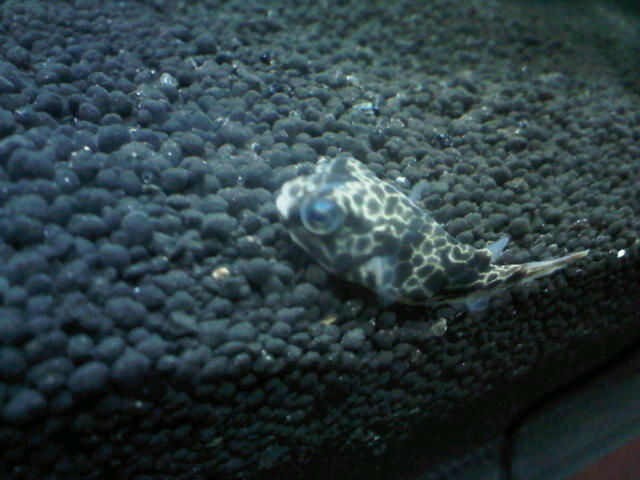
can somebody help me, for mbu puffer what is the best water parameter?
TDS
PH
GH
KH
Ammonia
Nitrite
Nitrate
phospat
etc
Fahaka------------------- Had to give it away Auriglobus modestus-----Traded Auriglobus silus ---------Died during transport. Figure Eight Puffers -----Sold and or traded Dwarf Puffers ------------Traded Congo Puffer ------------Traded South American Puffers -Traded Carinotetraodon lorteti --Died under my supervision :(
btw what negatife of nitrate ...
nitrate is good for plant i hear it, and for puffer?
i learn in water parameter is,
ammonia change to nitrate ( filter ) ...
nitrate change to nitrite ( plant )
nitrite change to ..... ( bio filter , plakton and bakteri food )
nitrite lost with water change.
i dont know its correct or mot, but maybe will help
My Puffers: Puffers I have kept: T lineatus T miurus A modestus T biocellatus C valentini C coranata C papuan C lorteti DPs suvattii burrfish T niphobles
That's pretty close. Ammonia/nitrite 0 at all times (both toxic to fish), nitrate <20 but <10 is even better. In an established FW tank it would be rare to see nitrate of 0, unless heavily filtered by plants. As far as pH, whatever your tap water is should be fine as long as it doesn't fluctuate much. You want low phosphate if you don't like algae in your tanks.
TDS/GH/KH is more of a concern in SW systems, especially reefs. Then you've got calcium & magnesium to be concerned about.
You are getting sleepy... you only hear the sound of my voice... you must do water changes... water changes... water changes... water changes...
because i have CRS shrimp and need to check about that,so for puffer i search in many links cant find the water parameter.
in shrimp TDS is very important, TDS in shrimp is 60-150ppm
can somebody tell me TDS in puffer?
because i have palembang puffer TDS is 424 is very high, but "bun" still "fine" and i check my mbu TDS is 121. range is so far, i dont know where is good.
My Puffers: Puffers I have kept: T lineatus T miurus A modestus T biocellatus C valentini C coranata C papuan C lorteti DPs suvattii burrfish T niphobles
Iiemail wrote:i learn in water parameter is,
ammonia change to nitrate ( filter ) ...
nitrate change to nitrite ( plant )
nitrite change to ..... ( bio filter , plakton and bakteri food )
nitrite lost with water change.
Just for information purposes, the bio filter converts ammonia > nitrite > nitrAte.
I'd love to see pictures of your puffer if you have some to post!
~ Candice With the following creatures in various tanks:
1 GSP with live rock and red mushrooms (viewtopic.php?f=9&t=25686)
1 Red-ear Slider Turtle—32-yrs-old!
1 African Cichlid - not sure of species
2 Green Terror Cichlids
2 Jack Dempsey Cichlids
~30 Jewel Cichlids
My Puffers: Puffers I have kept: T lineatus T miurus A modestus T biocellatus C valentini C coranata C papuan C lorteti DPs suvattii burrfish T niphobles
Iiemail wrote:i learn in water parameter is,
ammonia change to nitrate ( filter ) ...
nitrate change to nitrite ( plant )
nitrite change to ..... ( bio filter , plakton and bakteri food )
nitrite lost with water change.
Just for information purposes, the bio filter converts ammonia > nitrite > nitrAte.
I'd love to see pictures of your puffer if you have some to post!
Hey Iiemail, That's a little Mbu you have there. Btw, I 110% agree with the others about ammonia>nitrite>nitrate. Plants and wc's help keep nitrate levels low.
Chris,
He who knows best knows how little he knows - Thomas Jefferson
FADE2BLACK_1973 wrote:Hey Iiemail, That's a little Mbu you have there. Btw, I 110% agree with the others about ammonia>nitrite>nitrate. Plants and wc's help keep nitrate levels low.
hehehehe i wrong, and now many medcine can reduce nitrite and ammonia.
yes thats my little mbu ... she ate very much and dont want market shrimp dont want blood worm only want scalop.. she have good taste very funny.
TDS: Total dissolved solids. A measure of everything dissolved in the water, all ionized materials. The absolute number is not as important as changes in the number, particularly increases. The difference in the tank reading and tap water used for partial water changes is a measure of pollution.
pH (note: it is a lower case "p" and a capital "H"). This is a measure of the acidity or alkalinity of the water. A pH <7.0 is acid, a pH =7.0 is neutral, a pH >7.0 is alkaline (or basic). Here again, the absolute number is not particularly important for FW fish, but changes in the pH are. Decreases in the pH are an indicator of pollution. For T. mbu a pH >8.0 is not an issue. Likely <8.5 is desirable.
GH: Genera hardness, a measure of the calcium (Ca++) and magnesium (Mg++) ions in the water. the absolute number is again not as important as changes in the number - that is, differences in the GH of the tap water and the tank water indicate pollution.
KH: Carbonate/bicarbonate hardness. A measure of the carbonate and bicarbonate ions in the water. This again is a measure of pollution as shown by decreases in the KH. KH controls the pH of the water in the absence of added buffers. KH is used up in nitrification, so the number tends to decrease with time.
Ammonia: (NH4+ = ammonium ion; NH3 = ammonia gas or dissolved ammonia gas). Ammonia is the standard release form for nitrogen waste for aerobic living cells. It is highly toxic to living cells as dissloved ammonia gas. Ammonium ion is relatively non-toxic. The proportions between the two forms are controlled by the pH of the water and by the temperature. No detectable ammonia by hobby test kits is desirable.
Nitrite: (NO2-) is the first oxidation product from ammonia. It also is highly toxic in FW (less so in SW). As with ammonia. there should be no detectable nitrite by hobby test kits in fish tanks.
Nitrate: (NO3--) The final oxidation product from ammonia by bacteria. Nitrate is a bit toxic, but a lot less so than ammonia or nitrite. Nitrate should be below 20ppm (ppm = parts per million), better below 10ppm, best undetectable by hobby test kits, but that is rare in operating tanks.
Phosphate: (P04--) Phosphate is the commonest soluble form of phosphorous in tanks. Phosphorous is required by plants, animals and microbes, excessive levels indicate pollution.
My Puffers: Puffers I have kept: T lineatus T miurus A modestus T biocellatus C valentini C coranata C papuan C lorteti DPs suvattii burrfish T niphobles
My Puffers: Puffers I have kept: T lineatus T miurus A modestus T biocellatus C valentini C coranata C papuan C lorteti DPs suvattii burrfish T niphobles