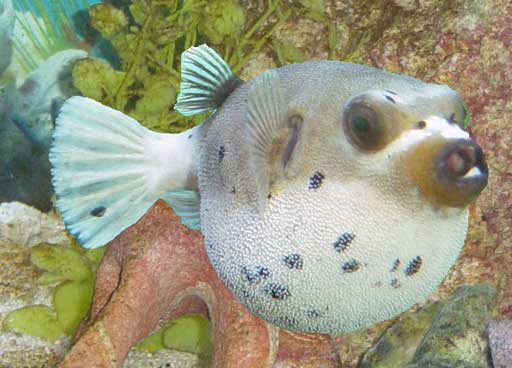
Retractable teeth?
-
Boxermom

- Former Staff Member
- Posts: 2182
- Joined: Sun Mar 12, 2006 8:34 pm
- Location: Wisconsin
- Contact:
Retractable teeth?
Do puffers have retractable teeth? Or not retractable exactly, but foldable? Or tongues? I've noticed with my fahaka, he appears to have two flaps that sorta look like teeth or a tongue (but there's a line in the center, like a seam) on the bottom of his mouth. No otherwise apparent teeth on the bottom though, at least not apparently upon cursory view. But I know his teeth work, he's definitely able to crunch up snail shells like there's no tomorrow.
Tina
Puffers: Auriglobus silus x1, Tetraodon travancoricus x1, Tetraodon turgidus x1, Tetraodon miurus x1, Tetraodon nigroviridis x2, Tetraodon baileyi x2, Tetraodon lineatus x1, Tetraodon palembangensis x1
Puffers: Auriglobus silus x1, Tetraodon travancoricus x1, Tetraodon turgidus x1, Tetraodon miurus x1, Tetraodon nigroviridis x2, Tetraodon baileyi x2, Tetraodon lineatus x1, Tetraodon palembangensis x1
-
Nick
- Former Staff Member
- Posts: 3231
- Joined: Sun Oct 22, 2006 8:47 pm
- My Puffers: Mine:
GSPs - Shakespeare and Jillybean
F8 - Velvet
My fiance:
DP - Emma Goldman
Narrow Lined Puffer - Ulrike - Location (country): Northeastern USA
- Location: Middletown, CT
- Contact:
I think the teeth do pull back very far, they definately come way out of Shakespeare's mouth when he's "in the zone" working on a large snail. I think the thing you're seeing on the bottom of the mouth is something like an unflapped tounge, used for swallowing. I've seen in on Kiwi when he was panting.
No matter how magnificent your successes or devastating your failures, the worlds' approximately 5 billion impoverished people could not possibly care less.

-
Boxermom
- Former Staff Member
- Posts: 2182
- Joined: Sun Mar 12, 2006 8:34 pm
- Location: Wisconsin
- Contact:
Anyone have any further thoughts about this? I honestly don't think Linus has bottom teeth but has sort of a flexible plate on the bottom that has a seam, sort of like if his teeth were folded in. When he eats, he seems to crush the shells against the plate to break them. Doesn't seem to bite them like the other puffers do.
Tina
Puffers: Auriglobus silus x1, Tetraodon travancoricus x1, Tetraodon turgidus x1, Tetraodon miurus x1, Tetraodon nigroviridis x2, Tetraodon baileyi x2, Tetraodon lineatus x1, Tetraodon palembangensis x1
Puffers: Auriglobus silus x1, Tetraodon travancoricus x1, Tetraodon turgidus x1, Tetraodon miurus x1, Tetraodon nigroviridis x2, Tetraodon baileyi x2, Tetraodon lineatus x1, Tetraodon palembangensis x1
-
messy_da_legend

- Figure 8 Puffer
- Posts: 223
- Joined: Sat Feb 25, 2006 4:53 pm
- My Puffers: M. baileyi called Esau
- Location: Ipswich UK
-
Corvus

- Mentor
- Posts: 1405
- Joined: Mon Dec 04, 2006 10:35 am
- Gender: Male
- Location: Planet earth; mostly Germany recently
Their name (Tetraodon) comes from having four teeth: 2 in the upper jaw and two in the lower jaw.On most of our puffers the ones in the upper jaw are just more prominent.
Have a look at this Arothron e.g.:
http://fins.actwin.com/pics/Arothron_ni ... tatus3.jpg
Have a look at this Arothron e.g.:
http://fins.actwin.com/pics/Arothron_ni ... tatus3.jpg
Give a man a fish, and he'll eat for a day. Give a fish a man, and he'll eat for weeks.
-
Corvus
- Mentor
- Posts: 1405
- Joined: Mon Dec 04, 2006 10:35 am
- Gender: Male
- Location: Planet earth; mostly Germany recently
Another one is
http://www.palais-portedoree.org/images ... _1_032.jpg
On Arothron all four teeth are observed most easily. If you happen to watch a larger Carinotetraodon such as irrubesco, lorteti etc. you'll see their teeth in the lower jaw often, too.
http://www.palais-portedoree.org/images ... _1_032.jpg
On Arothron all four teeth are observed most easily. If you happen to watch a larger Carinotetraodon such as irrubesco, lorteti etc. you'll see their teeth in the lower jaw often, too.
Give a man a fish, and he'll eat for a day. Give a fish a man, and he'll eat for weeks.
-
Boxermom
- Former Staff Member
- Posts: 2182
- Joined: Sun Mar 12, 2006 8:34 pm
- Location: Wisconsin
- Contact:
Yes, I'm aware of what tetraodon means. And I know what their beaks normally look like. What I'm saying is that Linus' beak does not look like that. He does not have a bottom beak like most other puffers I've seen, and I'm wondering if that is normal. His appear to lay against the bottom of his mouth, like a tongue or a plate, rather than teeth sticking up.
Tina
Puffers: Auriglobus silus x1, Tetraodon travancoricus x1, Tetraodon turgidus x1, Tetraodon miurus x1, Tetraodon nigroviridis x2, Tetraodon baileyi x2, Tetraodon lineatus x1, Tetraodon palembangensis x1
Puffers: Auriglobus silus x1, Tetraodon travancoricus x1, Tetraodon turgidus x1, Tetraodon miurus x1, Tetraodon nigroviridis x2, Tetraodon baileyi x2, Tetraodon lineatus x1, Tetraodon palembangensis x1
-
OraLacerta

- Former Staff Member
- Posts: 573
- Joined: Mon Apr 17, 2006 12:51 am
- Gender: Female
- My Puffers: Tetraodon biocellatus.
RIP: C. travancoricus, Chilomycterus schoepfi. Canthigaster jactator. - Location (country): USA
- Location: USA
Strange. It is possible he may have a deformity, but he seems like he manages just fine. Is there anyway you could photograph it? I know, quite the task, but it may help us figure this out.
-Michelle
Prevent unnecessary deaths due to disease- quarantine ALL new additions at least 4 weeks in a separate tank before adding to your main display tank!
Puffers: Hindenburg the Figure Eight, 75gallon Brackish
Prevent unnecessary deaths due to disease- quarantine ALL new additions at least 4 weeks in a separate tank before adding to your main display tank!
Puffers: Hindenburg the Figure Eight, 75gallon Brackish
-
Boxermom
- Former Staff Member
- Posts: 2182
- Joined: Sun Mar 12, 2006 8:34 pm
- Location: Wisconsin
- Contact:
You can sorta see it in these photos. Its pointed up in the middle, like its folded in half or something. It moves up and down slightly as he breathes, but mostly lays flat against his lower jaw. I'm not all that worried about it as it does seem he's doing quite well and growing like a weed.  Mostly just curious to know if its normal for fahakas.


Mostly just curious to know if its normal for fahakas.Tina
Puffers: Auriglobus silus x1, Tetraodon travancoricus x1, Tetraodon turgidus x1, Tetraodon miurus x1, Tetraodon nigroviridis x2, Tetraodon baileyi x2, Tetraodon lineatus x1, Tetraodon palembangensis x1
Puffers: Auriglobus silus x1, Tetraodon travancoricus x1, Tetraodon turgidus x1, Tetraodon miurus x1, Tetraodon nigroviridis x2, Tetraodon baileyi x2, Tetraodon lineatus x1, Tetraodon palembangensis x1
-
OraLacerta
- Former Staff Member
- Posts: 573
- Joined: Mon Apr 17, 2006 12:51 am
- Gender: Female
- My Puffers: Tetraodon biocellatus.
RIP: C. travancoricus, Chilomycterus schoepfi. Canthigaster jactator. - Location (country): USA
- Location: USA
Hmm, I see what you are talking about, but it's obvious after looking at the pictures we'd have to actually see the fish moving to really discern what that is. Whether his teeth are deformed or not it's just too hard to tell.
I know my puffs have sort of a 'tongue' that moves up and down as they breathe, but it doesn't look split in two like that.

I know my puffs have sort of a 'tongue' that moves up and down as they breathe, but it doesn't look split in two like that.
-Michelle
Prevent unnecessary deaths due to disease- quarantine ALL new additions at least 4 weeks in a separate tank before adding to your main display tank!
Puffers: Hindenburg the Figure Eight, 75gallon Brackish
Prevent unnecessary deaths due to disease- quarantine ALL new additions at least 4 weeks in a separate tank before adding to your main display tank!
Puffers: Hindenburg the Figure Eight, 75gallon Brackish
-
RTR
- Mentor
- Posts: 6155
- Joined: Tue May 31, 2005 4:39 pm
- Gender: Male
- Location (country): East Coast, USA
I do not believe that puffer's dental plates (fused teeth) are at all moveable in their bony jaws (as some snakes can do in swallowing prey or to errect and lock fangs). But their lips and cheeks certainly are. Most bony fish have heads of fixed contours with allowance for whatever degree of jaw mobility their species uses. In part due to their lack of rigidity (inclding the lack of a firm operculum), muscles do more work where others have firmer structures. The flap descibed is part of breathing, blocking water from moving forward out of their mouth and forcing it to flow back and out through the gills as the buccal cavity is compressed.
I don't have a fahaka now, but watch when the fish begs or pushes against the glass - that may well expose the lower dental plates. I do remember them "grimacing" (my label) and pulling the lips back to expose both upper and lower plates as part of eating, commonly with the mouth closed and just before opening the mouth and spitting out forward bits of shell, from their pharyngeal grinding of food, etc.
I don't have a fahaka now, but watch when the fish begs or pushes against the glass - that may well expose the lower dental plates. I do remember them "grimacing" (my label) and pulling the lips back to expose both upper and lower plates as part of eating, commonly with the mouth closed and just before opening the mouth and spitting out forward bits of shell, from their pharyngeal grinding of food, etc.
Where's the fish? - Neptune
-
Boxermom
- Former Staff Member
- Posts: 2182
- Joined: Sun Mar 12, 2006 8:34 pm
- Location: Wisconsin
- Contact:
Ahh, sorta like the dingleberry that hangs in the back of our throat, eh? That makes sense, thanks!RTR wrote:The flap descibed is part of breathing, blocking water from moving forward out of their mouth and forcing it to flow back and out through the gills as the buccal cavity is compressed.
He hasn't pushed against the glass like many of my others have. The one time he did was when I had my head up against the glass and he was trying to eat my hair.RTR wrote:I don't have a fahaka now, but watch when the fish begs or pushes against the glass - that may well expose the lower dental plates. I do remember them "grimacing" (my label) and pulling the lips back to expose both upper and lower plates as part of eating, commonly with the mouth closed and just before opening the mouth and spitting out forward bits of shell, from their pharyngeal grinding of food, etc.
 I'll have to see if I can get him to do it in a position where I can see him though, I couldn't see him doing it before.
Tina
Puffers: Auriglobus silus x1, Tetraodon travancoricus x1, Tetraodon turgidus x1, Tetraodon miurus x1, Tetraodon nigroviridis x2, Tetraodon baileyi x2, Tetraodon lineatus x1, Tetraodon palembangensis x1
Puffers: Auriglobus silus x1, Tetraodon travancoricus x1, Tetraodon turgidus x1, Tetraodon miurus x1, Tetraodon nigroviridis x2, Tetraodon baileyi x2, Tetraodon lineatus x1, Tetraodon palembangensis x1