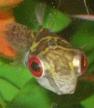
So I just set up a new 10-gal tank, cycled with Bio-Spira, and added 2 female Red-eyed puffers (C. irrubesco). They were the only two at the store. One (Alaska) is a plump, healthy girl, but the other one (Aloha) seems a bit skinny. The puffs were two-for-one so I figured I'd get both and try to fatten up the littler girl. I put tons of plastic plants and hidey-holes in the tank so hopefully they will not hurt one another.
I'm worried Aloha may have parasites. What would the best and safest treatment be to treat for parasites if I can't get her to plump up over the next week or so? Both girls ate a bellyfull of live bloodworms today and seem quite healthy and chipper in all other respects. I'll update over the next few days as they settle in.
I have a pair of irrubesco, and for the first day or two they were a bit shy and the male definitely bullied the female. But adding some dither fish seemed to help; I use Otocinclus, cardinal tetras, and any odd halfbeak fry I have lying about. These do seem to encourage the puffers to swim out in the open.
The other thing I've learned is that they really only eat in the morning, within 30 minutes of turning the lights on. In fact, that's when they'll be looking for food outside their caves (coconut shells). While they will eat food later on in the day, it's less reliable, and often they just ignore the food.
Mine like bloodworms and small pond snails. Live mosquito larvae are popular, too.
They're now definitely a pair, and rest together in the Java ferns during the day. The female is round as a ball, it's quite something to see!
Thanks for the feeding tips! I've been keeping the light off since we've been having a heat wave (116 yesterday) and every little bit helps to cool the poor fish down. I turned on the light this evening for feeding and sure enough, even the bigger girl (Alaska) who seems very reclusive, came out for some bloodworms.
Oddly enough, Aloha (the skinny girl) is much more personable--always comes up to the glass to say hi--while the big, healthy girl likes to hide behind the water wisteria.
Tanks:
20-gal feeder breeder (platties and snails)
75-gal West African Lungfish + snails
Other pets: Pacific parrotlet, Italian Greyhound, lots of plants
No bloodworms are midge larvae (family Chironomidae) whereas mosquitos are a family of their own, the family Culicidae. So, like cats and dogs, similar, but different.
But that's splitting hairs from the fish's perspective. Mosquito larvae I happen to collect live from my garden and my neighbour's garden, and bloodworms I buy frozen. My puffers prefer the frozen bloodworms because they sink, but they do eat any live mosquito larvae they can catch.