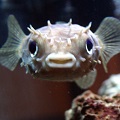
We've never seen this before. No-Name-Yet is in the background of the image. The yellow object toward the foreground is where he took an approximately 1/2 tsp dump that formed a puddle on the sand about the size of a quarter. It disintegrated when suctioned out so I couldn't look at it with a microscope.
For the last couple days he has been lethargic and seemed to contort the back end of his tummy like he was, perhaps, constipated. Now this and he's all happy and fluttering around the tank again.
Could a grocery store Littleneck clam we fed him two days ago cause a sour stomach?
Solid yellow puddle of poop? What's up with that?
A&R
My Puffers: Puffers I have kept: T lineatus T miurus A modestus T biocellatus C valentini C coranata C papuan C lorteti DPs suvattii burrfish T niphobles
He is about 5.25" (13.3 cm) and gets 4-6 varied size frozen krill*** per day or similar amounts of frozen clam, scallop, or shrimp. Once so far we fed the smallest live Littleneck clam in the grocery store cracked part way open, which he slurped out in one bite anyway. This was his biggest meal to date. He probably could have eaten several of them if we offered more. That was all he got that day. A week ago we gave him a small live fiddler crab, he took the claw first and swallowed it whole. I don't think we are even close to over feeding as after feeding his stomach usually doesn't bulge noticeably.
We started him on Hikari sinking carnivore pellets, which he will eat if he notices it (probably need larger pellets).
We usually feed twice per day offering half the amount above.
No parasites are noticeable in his feces or hanging from his anus. Prazi and Metro meds are on order to put in his food.
We have read that clams sealed tight with seawater inside may go foul due to their own ammonia even though alive. This clam was sealed tight like that and probably should have been placed in seawater until it opened and was flushed out rather than just washing it off after it was cracked open.
-R
*** We were told he was fed krill at DD. We are, of course, introducing new foods, but puffer crack can be a hard habit to kick. ~A
My Puffers: Puffers I have kept: T lineatus T miurus A modestus T biocellatus C valentini C coranata C papuan C lorteti DPs suvattii burrfish T niphobles
Thanks PP. We were following the general fish feeding strategy of small amounts a couple times per day, but once per day skipping every third makes sense.
-R
Here is an update on No-Name-yet, whose lethargy since the power head encounter has us concerned. The white circular scratch marks on his back from the power head are now just two little spots that will most likely be gone within another day or two. Since getting sucked and fully inflating he has been lethargic and sleeping almost continuously. He sits on his belly nestled against the rocks changing position from time to time but otherwise moves only enough to take food delivered directly in front of him. He won't venture even a few inches to get it himself. The power head injury looked minor, he didn't seem to be bothered by for the first 24-36 hours, and he was not stuck on the power head intake for long, so this may not be the cause of the problem
He only tracks movement with his eyes in response to large movements, or when food is around. He seems to stare off into space but shifts his vision occasionally to look at something in the room. He no longer rushes to see what might be in the feeding net, when food is wiggled at the glass, or when fingers are moved around quickly on the glass. He is capable of swimming normally. We've seen swim do so for a very short time on a couple occasions since getting sucked.
Reading on the forum, a quick onset of lethargy is a very common report, but also one that usually seems to end badly. On the other hand, I often wonder if fish owner response kills a sick fish that might otherwise recover. We always feel the urgent desire to do something to fix the problem.
He seems to pump his gills hard a bit just after waking up to eat, but respiration is 1 every 2-3 sec (edited to correct) or less while at rest. He may just be clearing debris from gills after resting for longer than usual periods. He doesn't lodge against the filter intake, orient with mouth open facing the current, or go to the surface for air.
There are no visible indications of parasites, but we treated two of three days with frozen krill soaked 20 min in Metronidazole (1tsp/100mg). He would only eat a little (seemed to hate taste). Adding garlic to the soak on day two didn't help; he spit out the second krill and let the chewed up pieces sit in front of him until we netted them out.
We plan to treat with Prazi soon but don't want to add to food due to overdosing danger (Bob Fenner). Treatment of water is fairly harmless in a tank like ours where the Prazi won't kill things living in the rocks, but the Prazi may also reduce O2 or degrade redox (I don't know).
Yellow puddles of fecal matter stopped even before we got the Metronidazole by mail order. We must mail order because almost all the LFSs in Maine went bankrupt after many very popular fresh water aquarium fish, from Koi to Kissing Gouramis and Kife Fish, were made illegal to own by the state. My current thinking is that the fecal irregularities were caused when we fed a grocery store little-neck clam that sealed itself with seawater inside. Instead of putting it in seawater to open and expel pollutants, I broke it open and gave it only a quick rinse before feeding.
OK, someone will ask, so here are the tank/filter/water stats.
Tank 40 gallons (actual). He'll go in our 75 or 150 after quarantine.
Filtration: Eshopps 18" x 12" x 16" Wet-Dry with:
3 Aquaclear 110 ceramic media added to the bio-balls
1 Aquaclear 110 foam block added to sump floor for additional surface area
No carbon (removed when we began adding a vitamin supplement that is mostly vitamin C).
300gph aimed across water surface toward opposite tank wall to keep water movement down.
CoralLife 36-Watt UV (3rd unit, first 2 leaked, returned when different O-rings leaked). We don't recommend this product.
CoralLife Superskimmer 125 (hung outside sump) foam too wet to collect. Also not recommended - foam level change with sump water level - prone to overflows.
A four inch air stone very generously supplied with a large dedicated air pump provides lots of surface water movement.
Water parameters:
Ammonia: 0ppm;
Nitrite: 0ppm;
Nitrate: 0ppm;
pH 8.0 (am) to 8.2 (pm) monitored continuously
Temp 75F
Water changes just reduced to 25% every other day, matching Temp, pH, sg.
SG 1.015 (keeping a bit low to reduce energy used by fish osmosis and to increase O2 in water).
Feeding:
1x day, 2 days on & 1 off as PP advised.
Yesterday:
1 Hikari frozen clam on the half shell (taken in one slurp, shell left in tank because he chews on it every so often.
1 Hikari Sinking Massivore Delight pellet (swallowed whole)
-R
Last edited by FishFan on Tue Jan 21, 2014 4:49 pm, edited 2 times in total.
My Puffers: Puffers I have kept: T lineatus T miurus A modestus T biocellatus C valentini C coranata C papuan C lorteti DPs suvattii burrfish T niphobles
My Puffers: Puffers I have kept: T lineatus T miurus A modestus T biocellatus C valentini C coranata C papuan C lorteti DPs suvattii burrfish T niphobles
Pufferpunk wrote:I wouldn't expect that to make much, if any difference in your tank. How much VC is in there?
3527 mcg/ml
It is really a food soak for omega-3 fatty acids, and I agree that the C is too low to do anything in the tank. I thought the tiny print on the back label said mg/l but it is really 3.5 grams per liter. If we used more in the tank it would leave an oil slick on the surface and get removed by filters anyway. Doh!
My Puffers: Puffers I have kept: T lineatus T miurus A modestus T biocellatus C valentini C coranata C papuan C lorteti DPs suvattii burrfish T niphobles