+1 to Pufferpunk's comments above. Endopthalmia is quite uncommon from osmotic issues resulting from sudden excessive density issues compared to being common/almost expected from fish starving from whatever reason. When a fish has not been fed or eating for an extended period, the fat pads behind the eyes (which cushions them and support their ability to move them within their sockets normally. Hobbyists see it quite frequently in suckermouth catfish which have been too long in transit from the wild without feeding. It is the commonest cause of high losses in freshly received Otocinclus catfish in LFS. Such fish lose their gut microbes in extended starvation and can starve even when currently being fed properly. This is not often seen in puffers (less demanding gut microbes than highly specialized suckermouth cats), but is always an outside possibility. Puffers are quite catholic in their food consumption, especially many of the BW-SW members of the family. They can and will eat nearly anything. The family has many highly adaptable members, but only one which is adaptable to almost any habitat circumpolar within the tropics and much of the subtropics - the fish we (currently) call the GSP. They can be killed by osmotic shock, but not as easily as most of their kin, and that is most often a very short-term process. I won't say it is impossible, but it is unlikely.
FWIW
Green Spotted Puffer Problems. Constipation? Overheating.
Forum rules
Read this before posting!!
Since this board has been up, we have found there are several questions that routinely get asked in order to help diagnose problems. If you can have that information to begin with in your post, we'll be able to help right away (if we can!) without having to wait for you to post the info we need.
1) Your water parameters - pH, Ammonia, Nitrite, Nitrates and salinity (if appropriate). This is by far the most important information you can provide! Do not answer this with "Fine" "Perfect" "ok", that tells us nothing. We need hard numbers.
2) Tank size and a list of ALL inhabitants. Include algae eaters, plecos, everything. We need to know what you have and how big the tank is.
3) Feeding, water change schedule and a list of all products you are using or have added to the tank (examples: Cycle, Amquel, salt, etc)
4) What changes you've made in the tank in the last week or so. Sometimes its the little things that make all the difference.
5) How long the aquarium has been set up, and how did you cycle it? If you don't know what cycling is read this: Fishless Cycling Article and familiarize yourself with all the information. Yes. All of it.
We want to help, and providing this information will go a LONG way to getting a diagnosis and hopeful cure that much faster.
While you wait for assistance:
One of the easiest and best ways to help your fish feel better is clean water! If you are already on a regular water change schedule (50% weekly is recommended) a good step to making your fish more comfortable while waiting for diagnosis/suggestions is to do a large water change immediately. Feel free to repeat daily or as often as you can, clean water is always a good thing! Use of Amquel or Prime as a dechlor may help with any ammonia or nitrite issues, and is highly recommended.
Note - if you do not normally do large water changes, doing a sudden, large water change could shock your fish by suddenly changing their established water chemistry. Clean water is still your first goal, so in this case, do several smaller (10%) water changes over the next day or two before starting any large ones.
-
RTR
- Mentor
- Posts: 6155
- Joined: Tue May 31, 2005 4:39 pm
- Gender: Male
- Location (country): East Coast, USA
Re: Green Spotted Puffer Problems. Constipation? Overheating
Where's the fish? - Neptune
-
lstreet
- Puffer Fry
- Posts: 10
- Joined: Tue Nov 26, 2013 9:37 am
- My Puffers: Green Spotted Puffer named Gordon Puff. He's been a member of the family for one year this December 2013.
- Location (country): Central Florida
Re: Green Spotted Puffer Problems. Constipation? Overheating
Thank you for the follow up comments. The sunken eyes were bilateral, affecting both equally. It occurred only after Gordon was transferred to quarantine and treated with Epsom salt on top of a 30‰ salinity. The water in quarantine was the same water from his 55 gal bow front, as we wanted to maintain parameters as much as possible between tanks at first because we thought he was only suffering from constipation.
Gordon suffered sunken eyes for three days. After three 50% water changes plus reduced salinity, both eyes resumed normal healthy rounded appearance and functions, equally and bilaterally. If sunken eyes were a product of starvation, I would suppose that they would not have returned to a normal functioning state, but then again, I'm no fish expert -- it was only a hypothesis. I acted on the only information I could find about sunken eyes in fish, and the solution worked.
On the fourth day a few hours before Gordon died, we did attempt a burping, with no sucess.
My fiancé, who is a surgeon, performed a post-mortem autopsy on Gordon. Gordon was not a "he" -- She had a very large roe, surrounding her entire stomach and internal organs. It was the largest organ in her little tummy and it was the reason why she appeared so large and well-rounded looking. At first diagnosis, we thought it was a tumor. My fiancé had seen a tumor of the thyroid in a patient that looked similar to Gordon's roe. But we all know the puffers don't have thyroids. Heh. All of her organs appeared perfectly healthy and she had no internal parasites. There was an organ, separate of the stomach, that appeared to look like a swim bladder, but I've read many places on this forum and others that puffer fish do not have swim bladders. The autopsy showed perfect signs of health except for a small empty belly, which was saddening. It's amazing the similarity between fish and human internal anatomy.
We had a funeral for Gordon last night. I don't think I will get another puffer fish. Gordon was an awesome fish, well-loved with a great personality. I don't want to replace that. I am going to turn my 55 gallon into a reef tank. We previously maintained a 125 gallon reef tank for 4 years before we had to move and sell the entire set up. Everyone was super healthy, pretty to look at, and very low maintenance compared to taking care of darling little puffer fish.
-
Pufferpunk

- Queen Admin
- Posts: 32987
- Joined: Tue May 31, 2005 11:06 am
- Gender: Female
- My Puffers: Puffers I have kept:
T lineatus
T miurus
A modestus
T biocellatus
C valentini
C coranata
C papuan
C lorteti
DPs
suvattii
burrfish
T niphobles - Location (country): USA, Greenville, SC
- Location: Greenville, SC
- Contact:
Re: Green Spotted Puffer Problems. Constipation? Overheating
Puffers are Catholic??? 
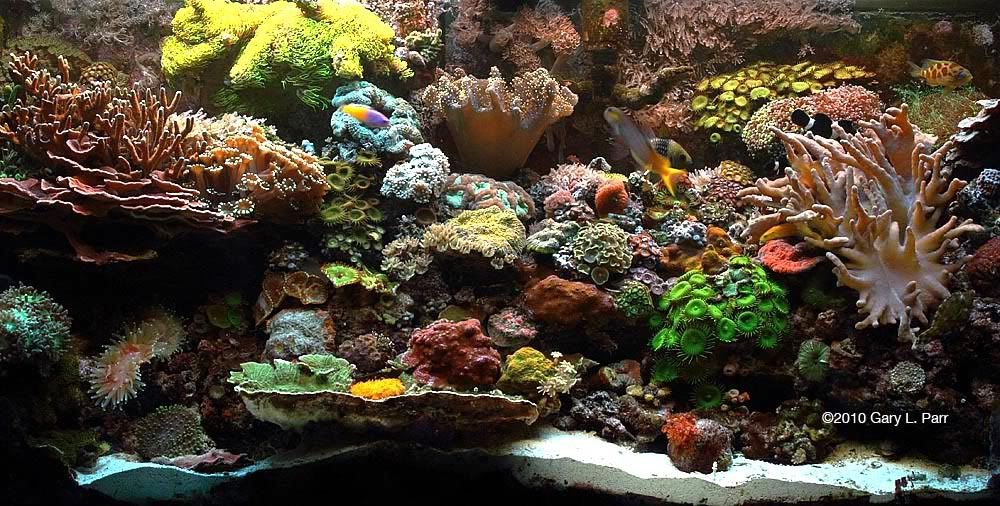
We do have a Marine Tank forum here.
Here's 1 of mine:
We do have a Marine Tank forum here.
Here's 1 of mine:
You are getting sleepy... you only hear the sound of my voice... you must do water changes... water changes... water changes... water changes...
"The solution to pollution is dilution!"
"The solution to pollution is dilution!"
-
lstreet
- Puffer Fry
- Posts: 10
- Joined: Tue Nov 26, 2013 9:37 am
- My Puffers: Green Spotted Puffer named Gordon Puff. He's been a member of the family for one year this December 2013.
- Location (country): Central Florida
Re: Green Spotted Puffer Problems. Constipation? Overheating
Wow! That is a handsome tank! Thank you for sharing!