Hello
-
J-P

- Former Staff Member
- Posts: 5626
- Joined: Tue Oct 13, 2009 12:21 am
- Gender: Male
- Location (country): Japan
- Location: Sasebo, Nagasaki, Japan
Re: Hello
it can be done, but keeping it simple is the best way to go.
if you follow me, you avoid stepping in the crap that I just did...
https://www.youtube.com/channel/UCZR55G ... pqlgec1A2Q
https://www.youtube.com/channel/UCZR55G ... pqlgec1A2Q
-
Pufferpunk

- Queen Admin
- Posts: 32987
- Joined: Tue May 31, 2005 11:06 am
- Gender: Female
- My Puffers: Puffers I have kept:
T lineatus
T miurus
A modestus
T biocellatus
C valentini
C coranata
C papuan
C lorteti
DPs
suvattii
burrfish
T niphobles - Location (country): USA, Greenville, SC
- Location: Greenville, SC
- Contact:
Re: Hello
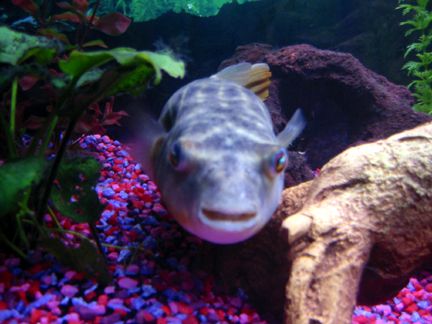
My fahaka started out at 1" in a 15g. At 3" he was moved to a 29g, 5" to a 55g & 7" to the 125 he's in now. I wish, wish, wish I had the space for something 2x that for him. I know you aren't sure if it's worth upgrading or wasting an entire 210 on this fish. You won't regret it! Imagine having a fish that acts like a puppy dog, happily greeting you every time you walk into the room, doing a happy dance, spreading it's gorgeous huge yellow tail at you.
You are getting sleepy... you only hear the sound of my voice... you must do water changes... water changes... water changes... water changes...
"The solution to pollution is dilution!"
"The solution to pollution is dilution!"
-
RTR
- Mentor
- Posts: 6155
- Joined: Tue May 31, 2005 4:39 pm
- Gender: Male
- Location (country): East Coast, USA
Re: Hello
Yes, exactly!
It took me decades to realize that "moving fish up" in tank size guaranties that the final fish size will always be smaller than the maximum size in the wild. This is called "stumting". That is not the death sentence many folks think that it is, there are degrees of damage involved. There are many, many differences between captive fish-keeping and wild survival. Only a tiny percentage of wild fish live to full maturity. There is no reason for captive reared fish not to always live longer and healthier lives than their wild cousins, and to long outlive those wild kin.
But if the best and healthiest life for captives is your goal, the only way that I know to achieve that is to move the fish into its permanent home from its quarantine tank (aka QT), which means setting its lifetime home while while confirming it health in the first weeks of its time in your care.
You mistake, your fallacy, is in thinking of the fish at its current size, not its adult size. I calculate only QT on that basis of current size. Doing that during the fish's juvenile life stage effectively guarantees that the fish will not achieve full adult size, ever. Puffers are relatively long-lived fish, and most are high personality fish. But they do need a lot of room ASAP or they do not ever grow up. Their lives may well be shortened, depending both on tank size, proper feeding, and water quality.
It is personal choice. If you want a wet pet only for a year or two, I cannot offer any advice. That is not any part of the way in which I keep fish.
It took me decades to realize that "moving fish up" in tank size guaranties that the final fish size will always be smaller than the maximum size in the wild. This is called "stumting". That is not the death sentence many folks think that it is, there are degrees of damage involved. There are many, many differences between captive fish-keeping and wild survival. Only a tiny percentage of wild fish live to full maturity. There is no reason for captive reared fish not to always live longer and healthier lives than their wild cousins, and to long outlive those wild kin.
But if the best and healthiest life for captives is your goal, the only way that I know to achieve that is to move the fish into its permanent home from its quarantine tank (aka QT), which means setting its lifetime home while while confirming it health in the first weeks of its time in your care.
You mistake, your fallacy, is in thinking of the fish at its current size, not its adult size. I calculate only QT on that basis of current size. Doing that during the fish's juvenile life stage effectively guarantees that the fish will not achieve full adult size, ever. Puffers are relatively long-lived fish, and most are high personality fish. But they do need a lot of room ASAP or they do not ever grow up. Their lives may well be shortened, depending both on tank size, proper feeding, and water quality.
It is personal choice. If you want a wet pet only for a year or two, I cannot offer any advice. That is not any part of the way in which I keep fish.
Where's the fish? - Neptune
-
bertie 83

- Moderator
- Posts: 5298
- Joined: Tue Apr 12, 2011 4:28 pm
- Gender: Male
- My Puffers: lineatus R.I.P, South American puffer. Valentini puffer, porcupine puffer.
Non puffer
Danios, Tetras, Redtail Rasporas,
Harlequins, CAE's, Yoyo
Loaches, Clown loaches ,Eels, various shrimp, tangs,wrasses, damsels, chromis - Location (country): Brighton, England
- Location: brighton , england
Re: Hello
I can only say +1 to pp and +1 to rtr. When I eventually do move my fahaka will have a monster tank, I am aware of how much fish thrive in extra space and aim to give it to all my fish
It's amazing how easy maintenance is. If done regularly and thoroughly