GSP research project
-
sevenyearnight

- Former Staff Member
- Posts: 1894
- Joined: Wed Aug 31, 2011 2:41 am
- Gender: Female
- My Puffers: T. nigroviridis
Balki Bartokomous - Location (country): USA
- Location: South Carolina
Re: GSP research project
Which puffer do you suspect, based on spots, (lots of tiny spots, or fewer larger spots) reaches the 6.5" duller colored as opposed to the smaller brighter colored one?

-
zombiefetus
- Fahaka Puffer
- Posts: 532
- Joined: Mon Jun 18, 2007 1:57 am
- Gender: Female
- Location (country): Illinois, USA
- Contact:
Re: GSP research project
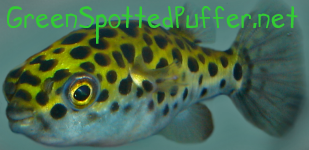
Based on what I know right now it seems like the easiest way to tell is that the GSPs that have very visible spines (appearing as evenly spaced white dots or as small bumps) are the ones that stay smaller (it also seems like more often than not they have spots that extend onto the fins and tail, but I'm not sure about this one). It also seems as though the head shape of the smaller puffers is more rounded while the face of the larger ones are more elongated.
It's hard to say if there is a specific spot pattern that indicates what type of GSP it is, but it's something I plan to keep an eye on.
It's hard to say if there is a specific spot pattern that indicates what type of GSP it is, but it's something I plan to keep an eye on.
-
Corvus

- Mentor
- Posts: 1405
- Joined: Mon Dec 04, 2006 10:35 am
- Gender: Male
- Location: Planet earth; mostly Germany recently
Re: GSP research project
Mmh... I can think of at least 3 "varieties"... The ones sometimes called T. cf. sabahensis (most likely look like GSP when young), "normal GSPs" and the ones that stay small (around 7 cm). I wonder if their differences qualify them as separate species and how to tell them apart when young for sure. Also important if they prefer different water qualities (see Hilly's specimen). These "ideas" should also be compared to Dekkers, who in fact had 3 GSP like species in his big work on SE Asian puffers.
Give a man a fish, and he'll eat for a day. Give a fish a man, and he'll eat for weeks.
-
zombiefetus
- Fahaka Puffer
- Posts: 532
- Joined: Mon Jun 18, 2007 1:57 am
- Gender: Female
- Location (country): Illinois, USA
- Contact:
Re: GSP research project
I was not counting T cf. sabahensis, but maybe I should since as far as I know we don't really have records of what they look like as juveniles.Corvus wrote:Mmh... I can think of at least 3 "varieties"... The ones sometimes called T. cf. sabahensis (most likely look like GSP when young), "normal GSPs" and the ones that stay small (around 7 cm). I wonder if their differences qualify them as separate species and how to tell them apart when young for sure. Also important if they prefer different water qualities (see Hilly's specimen). These "ideas" should also be compared to Dekkers, who in fact had 3 GSP like species in his big work on SE Asian puffers.
I wish I could locate more information on Dekkers findings. It seems his books are all hard to come by.
Since my knowledge of fish is limited for the time being I'm hoping I can keep detailed enough records to be useful as I learn more. For now I guess all I can really do is speculate and keep as detailed records as possible.
-
Corvus
- Mentor
- Posts: 1405
- Joined: Mon Dec 04, 2006 10:35 am
- Gender: Male
- Location: Planet earth; mostly Germany recently
Re: GSP research project
Possibly I can scan the relevant pages.
PS: also see the aqualog for suggested T. cf. sabahensis young.
PS: also see the aqualog for suggested T. cf. sabahensis young.
Give a man a fish, and he'll eat for a day. Give a fish a man, and he'll eat for weeks.
-
zombiefetus
- Fahaka Puffer
- Posts: 532
- Joined: Mon Jun 18, 2007 1:57 am
- Gender: Female
- Location (country): Illinois, USA
- Contact:
Re: GSP research project
If you could scan the pages for me you would be my hero.Corvus wrote:Possibly I can scan the relevant pages.
PS: also see the aqualog for suggested T. cf. sabahensis young.
I didn't realize the Aqualog mentioned them, I'll have to go look that up.
-
RVS

- Green Spotted Puffer
- Posts: 374
- Joined: Fri Aug 26, 2011 7:36 pm
- Gender: Male
- My Puffers: Currently:
2 T. Nigroviridis
20 C. Travancoricus.
Also Kept:
M. Abei
Other BF:
A hundred of Brackish P. Velifera & P. sphenops.
Pure Parambassis Ranga. - Location (country): Mexico lindo y querido!
Re: GSP research project
And why small spots and big spots (or other physical differences) in GSP are supposed to be a species difference?
Couldn't be a sexual dimorphism difference?
Couldn't be a sexual dimorphism difference?
Let there be light, and lit up the days... Let there be puffers, and they swam around the world...
PuffGenesis, 1, 1.
PuffGenesis, 1, 1.
-
Corvus
- Mentor
- Posts: 1405
- Joined: Mon Dec 04, 2006 10:35 am
- Gender: Male
- Location: Planet earth; mostly Germany recently
Re: GSP research project
Generally possible. However, this should be recognized with quite a good probability, because she plans to get them selected by their source and not by their looks. So, same-sex groups are possible, but less likely.
Give a man a fish, and he'll eat for a day. Give a fish a man, and he'll eat for weeks.