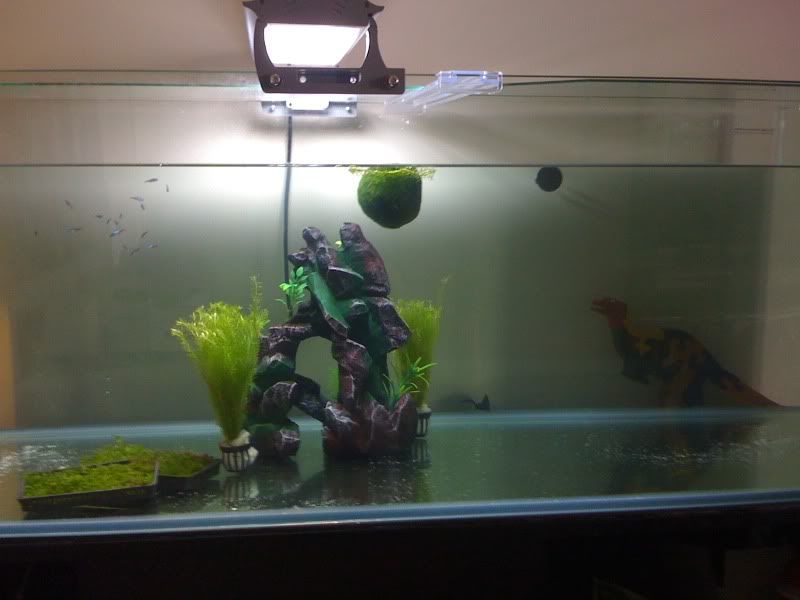
Just bucketing out the last remains of saltwater in my 60g tank. (only have a tiny bucket so its taking quite a while)
How concerned do I have to be about the remaining dregs of saltwater/substrate? Will Javamoss / small fish such as neon tetra mind it? If they are super sensitive to salt, then I will attempt to clean out the entire tank 100%....
Tank will mostly contain Marimo, javamoss and anacharis to start with Later planning to add tetras, discuses(perhaps), shrimp... depending on whats colourful and plentiful
If it's just dregs don't panic but get out as much as you can. Once full do a hefty waterchange. Tho it might be easier to give it a quick clean whilst empty
It's amazing how easy maintenance is. If done regularly and thoroughly
My Puffers: Puffers I have kept: T lineatus T miurus A modestus T biocellatus C valentini C coranata C papuan C lorteti DPs suvattii burrfish T niphobles
Id be careful keeping neons with discus, though I dont have experience with discus, I know they get decent size and may eat the neons. Plus im not sure about the neons in such low PH, discus prefer PH close to 6.0
RTR wrote:Fahakas do not have tank mates, they may have swimming food reserves.
xrayjeeper83 wrote:Id be careful keeping neons with discus, though I dont have experience with discus, I know they get decent size and may eat the neons. Plus im not sure about the neons in such low PH, discus prefer PH close to 6.0
hm true.
pH is around 7.5... how about harlequin rasbora?
Speaking of pH... just discovered my test kit has a pretty much empty bottle of pH test liquid?!? Is this normal? I'm pretty sure it was a new box... anywho, LFS won't take it back... contacted the company to see if I could get a replacement bottle lol :<
Our discus have been living for a year in water with a pH of ~8.5. I wouldn't worry They can't fertilize eggs but beyond that we've had no issues.
It is absurd to talk of one animal being higher than another. We consider those, when the cerebral structure/intellectual faculties most developed, as highest. A bee doubtless would when the instincts were.
Charles Darwin
Discus in the wild live and breed in low pH (actually, low GH is what matters for breeding). In captivity they will do just as well in higher pH, GH, & KH water, but cannot breed easily if at all. It is the egg membrane, not the parent fish, which is sensitive. Neons are from the same or similar wild conditions, and have the same or equal breeding water conditions.
Captive and wild conditions do not need to match. Low pH/GH/KH tanks are extremely tricky to maintain over long periods. Breeders of such fish tend to do massive daily water partials, up to 200%. Most breeders report better fry growth and development in more conventional water conditions once the fry are past parental slime grazing (o replacement foods for that early feeding). Obviously the change-over should not be sudden - osmotic shock would not be good. Such changes in TDS/osmolarity should be slow and carefully done.
Will discus eat shrimp?
I think I am pretty much set on neon tetras and ghost/tiger shrimp as my first tank inhabitants... don't want to risk discus dying on me on the first go >_<!
Oh you bet they will, ours love them and happily hunt them down in our heavily planted tank.
It is absurd to talk of one animal being higher than another. We consider those, when the cerebral structure/intellectual faculties most developed, as highest. A bee doubtless would when the instincts were.
Charles Darwin
My Puffers: Puffers I have kept: T lineatus T miurus A modestus T biocellatus C valentini C coranata C papuan C lorteti DPs suvattii burrfish T niphobles
I don't know any Discus nuts currently, but back when were closer to the city, I knew several. their houses were plumbed for Discus. Copper pipes for the humans, CPVC for the Discus, All tank were plumbed and drilled, water partials were semi-automatic and daily (you had to select 50%, 75%, or 90% drain and re-fill. All were bare-bottomed. They were hobby breeders. One of them also did Altum Angels - but never got a successful spawn.
If you have any local breeders, you may stand a better chance of success, but they are extremely demanding fish for most hobbyists. Your margins of safety are very tight.
 Later planning to add tetras, discuses(perhaps), shrimp... depending on whats colourful and plentiful