So...
-
Nick
- Former Staff Member
- Posts: 3231
- Joined: Sun Oct 22, 2006 8:47 pm
- My Puffers: Mine:
GSPs - Shakespeare and Jillybean
F8 - Velvet
My fiance:
DP - Emma Goldman
Narrow Lined Puffer - Ulrike - Location (country): Northeastern USA
- Location: Middletown, CT
- Contact:
 So...
No matter how magnificent your successes or devastating your failures, the worlds' approximately 5 billion impoverished people could not possibly care less.
-
mrgreen

- Fahaka Puffer
- Posts: 983
- Joined: Mon Mar 30, 2009 3:17 pm
- Gender: Female
- My Puffers: 1 dwarf puffer: Squirt
2 figure 8s: Escalator & Elevator - Location (country): United States
- Location: Michigan, USA
- Contact:
Re: So...
Look the same to me....
"Puffs puff cuz they're puffs cuz they puff cuz they're puffs. - Nathan age 12
-
LilGreenPuffer

- Former Staff Member
- Posts: 5301
- Joined: Sun Jan 25, 2009 11:26 pm
- Gender: Female
- My Puffers: Dwarf puffer - Thumbelina (only mine in my heart now; she lives in CT with my friend)
RIP Inigo Montoya, Fezzik, and Vizinni.
RIP James Bond. - Location (country): United States
- Location: Kentucky
Re: So...
PP's GSPs did the same, right? I remember Cricket and Bonzo looking very Sab.-like in their adult pic.
"I will give you a talisman. Whenever you are in doubt, or when the self becomes too much with you, apply the following test. Recall the face of the poorest and the weakest man whom you may have seen, and ask yourself, if the step you contemplate is going to be of any use to him or her. Will she gain anything by it? Will it restore her to a control over her own life and destiny? In other words, will it lead to freedom for the hungry and spiritually starving millions? Then you will find your doubts and your self melt away."
Found among the papers of Mohatma Gandhi

Come and visit http://www.thetriopsforum.com!
I AM A DUDETTE!
NEED NITRIFYING BACTERIA FOR YOUR NEW TANK? PM ME!
Found among the papers of Mohatma Gandhi
Come and visit http://www.thetriopsforum.com!
I AM A DUDETTE!
NEED NITRIFYING BACTERIA FOR YOUR NEW TANK? PM ME!
-
Pufferpunk

- Queen Admin
- Posts: 32987
- Joined: Tue May 31, 2005 11:06 am
- Gender: Female
- My Puffers: Puffers I have kept:
T lineatus
T miurus
A modestus
T biocellatus
C valentini
C coranata
C papuan
C lorteti
DPs
suvattii
burrfish
T niphobles - Location (country): USA, Greenville, SC
- Location: Greenville, SC
- Contact:
Re: So...
You are getting sleepy... you only hear the sound of my voice... you must do water changes... water changes... water changes... water changes...
"The solution to pollution is dilution!"
"The solution to pollution is dilution!"
-
Corvus

- Mentor
- Posts: 1405
- Joined: Mon Dec 04, 2006 10:35 am
- Gender: Male
- Location: Planet earth; mostly Germany recently
Re: So...
I think there is little doubt that T. cf. sabahensis look like GSP when young. I can only recommend to all interested in the topic to have a look at some of the scientific works on GSPs such as Dekkers: Review of the Asiatic freshwater puffers of the genus Tetraodon Linnaeus, 1758 in: Bijdragen tot de Dierkunde, 45/2, 1975 and also the pictures in the aqualog. Likely you won't find these online, but rather a library.
Give a man a fish, and he'll eat for a day. Give a fish a man, and he'll eat for weeks.
-
Hilly

- Mentor
- Posts: 1903
- Joined: Sun Jan 15, 2006 6:36 pm
- Gender: Male
- My Puffers: Current: Tetraodon Lineatus
Previous:
Tetraodon Sabahensis
Montrete Abei
Tetraodon Biocellatus
Carinotetraodon Salivator - Location (country): UK
- Location: Nottinghamshire, UK
Re: So...
The juvenile pic of Sabahensis in the Aqualog wasnt exactly brilliant:
And just to add a bit more confusion to it: Could a GSP turn into these?


There seem to be more variants of the fluviatilis family we dont see very often, either way they're all nice looking puffers. Just be nice if we saw them more often, never seem to be small ones though, does that re-enforce the part that perhaps they all look very similar when young.
And just to add a bit more confusion to it: Could a GSP turn into these?
There seem to be more variants of the fluviatilis family we dont see very often, either way they're all nice looking puffers. Just be nice if we saw them more often, never seem to be small ones though, does that re-enforce the part that perhaps they all look very similar when young.
Hilly
-
Corvus
- Mentor
- Posts: 1405
- Joined: Mon Dec 04, 2006 10:35 am
- Gender: Male
- Location: Planet earth; mostly Germany recently
Re: So...
Yes to all of them.Hilly wrote:And just to add a bit more confusion to it: Could a GSP turn into these?
One problem is that very very few GSP in captivity get old enough/have an adequate environment to grow to these adult colors.Hilly wrote: There seem to be more variants of the fluviatilis family we dont see very often, either way they're all nice looking puffers. Just be nice if we saw them more often, never seem to be small ones though, does that re-enforce the part that perhaps they all look very similar when young.
Another one is that many of their habitats are rarely to never sampled by taxonomists.
Give a man a fish, and he'll eat for a day. Give a fish a man, and he'll eat for weeks.
-
Hilly
- Mentor
- Posts: 1903
- Joined: Sun Jan 15, 2006 6:36 pm
- Gender: Male
- My Puffers: Current: Tetraodon Lineatus
Previous:
Tetraodon Sabahensis
Montrete Abei
Tetraodon Biocellatus
Carinotetraodon Salivator - Location (country): UK
- Location: Nottinghamshire, UK
Re: So...
That is a very good point. I was going to put if a Pustulatus can change its spots then I suppose anyting is possible. It would be nice if there was some new studies on them, but if there isnt it makes for a healthy debate.Corvus wrote: One problem is that very very few GSP in captivity get old enough/have an adequate environment to grow to these adult colors.
Another one is that many of their habitats are rarely to never sampled by taxonomists.
Could do with some of the oldest GSP pics from users on here and see how they compare.
Hilly
-
Corvus
- Mentor
- Posts: 1405
- Joined: Mon Dec 04, 2006 10:35 am
- Gender: Male
- Location: Planet earth; mostly Germany recently
Re: So...
As noted earlier there are at least three described species: T. nigroviridis, T. kretamensis and T. sabahensis (forget about finding good picture material using these names online). But which one is which (in case they are truly valid species at all) and how can they be told apart with the naked eye?
Give a man a fish, and he'll eat for a day. Give a fish a man, and he'll eat for weeks.
-
zombiefetus
- Fahaka Puffer
- Posts: 532
- Joined: Mon Jun 18, 2007 1:57 am
- Gender: Female
- Location (country): Illinois, USA
- Contact:
Re: So...
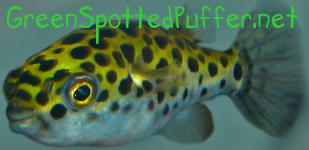
Some more interesting pics of older GSPs or sabahensis


^this last one really intrigues me. I with I knew the size of it. :/
^this last one really intrigues me. I with I knew the size of it. :/
-
Hilly
- Mentor
- Posts: 1903
- Joined: Sun Jan 15, 2006 6:36 pm
- Gender: Male
- My Puffers: Current: Tetraodon Lineatus
Previous:
Tetraodon Sabahensis
Montrete Abei
Tetraodon Biocellatus
Carinotetraodon Salivator - Location (country): UK
- Location: Nottinghamshire, UK
Re: So...
Now the last one is what I would expect an old adult GSP to look like with a lot od clearly defined spots, but then I look at PP's which are a good age and they have much fewer but larger spots. Granted there is a size difference.
OK heres a thought, could it be that as they age and due to their dispersion that their markings change depending on the environment (habitat/water conditions) that a particular one settles in the most. Could that be a possible reaon for a lot of variety in the markings in above pics.
OK heres a thought, could it be that as they age and due to their dispersion that their markings change depending on the environment (habitat/water conditions) that a particular one settles in the most. Could that be a possible reaon for a lot of variety in the markings in above pics.
Hilly
-
jus85411
- Mbu Puffer
- Posts: 1116
- Joined: Tue Jan 19, 2010 5:28 pm
- Gender: Male
- My Puffers: none currently :(
- Location (country): USA
- Location: Philadelphia Area
Re: So...
this is an interesting subject. the last picture there seems to have spots that go into their fins, where as the other two pictures dont seem to have those spots that go on the fins. could the spotting on fins have something to do with the differences in species? the Sabo's, at least in the puffer pedia, seem to have the spots that continue onto their fins but in the puffer pedia all GSP pictures and pictures from posts with pictures, seem to have clear fins without any spots. just an observation of those pictures and trying to brainstorm 
-
Nick
- Former Staff Member
- Posts: 3231
- Joined: Sun Oct 22, 2006 8:47 pm
- My Puffers: Mine:
GSPs - Shakespeare and Jillybean
F8 - Velvet
My fiance:
DP - Emma Goldman
Narrow Lined Puffer - Ulrike - Location (country): Northeastern USA
- Location: Middletown, CT
- Contact:
Re: So...
I have found one feature of older "gsp" that I have some confidence will be a determinant in identification, a "J" shaped pectoroventral crease in the belly on each side, starting at the "chin" with the curving part of the J going upwards, finishing just below the pectoral fin. It's VERY clear in a puffer you are looking at, but I have never seen it photographed and all my own attempts have failed. Shakespeare and Hannah's two new puffers all share this feature, not found on any juveniles.
No matter how magnificent your successes or devastating your failures, the worlds' approximately 5 billion impoverished people could not possibly care less.
-
Corvus
- Mentor
- Posts: 1405
- Joined: Mon Dec 04, 2006 10:35 am
- Gender: Male
- Location: Planet earth; mostly Germany recently
Re: So...
Can't exclude that, but don't think this is the only factor in play. I assume there are also possibly genetic differences in different populations. What's also remarkable is that some grow fast and reach larger sizes and others very slow to small sizes given the same environment. This might also be a hint for regional variations/different subspecies or species.Hilly wrote:OK heres a thought, could it be that as they age and due to their dispersion that their markings change depending on the environment (habitat/water conditions) that a particular one settles in the most. Could that be a possible reaon for a lot of variety in the markings in above pics.
Possible, however, these fish can have spotless fins when young that change into spotted fins when older. That's what I observed with some specimens. Therefore, this is hardly a usable character for the young specimens generally imported.jus85411 wrote:Could the spotting on fins have something to do with the differences in species?
For characters a very close look at the nostrils might reveal differences, at least Dekkers describes some.
Give a man a fish, and he'll eat for a day. Give a fish a man, and he'll eat for weeks.
-
SammyDee
- Mbu Puffer
- Posts: 1073
- Joined: Thu Sep 10, 2009 1:50 am
- Gender: Male
- My Puffers: 55g (2) GSP, (2) Maroon Clownfish, (1) blue damsel, And some soft corals and 1 Nem
45g FW community
20g snail and shrimp breeding tank for puffers - Location (country): USA USA USA USA
- Location: Detroit, Michigan
Re: So...
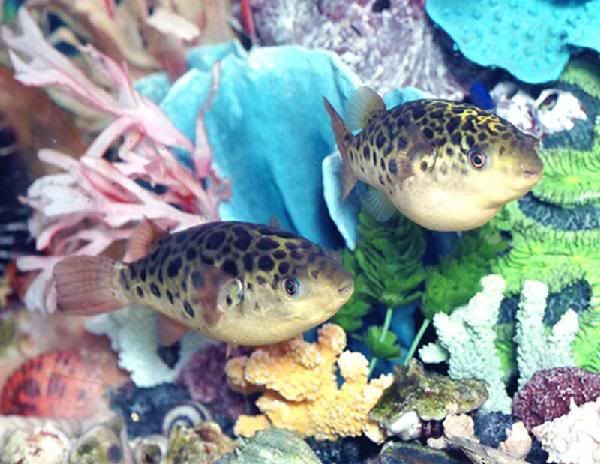
I think the gsp has solid jet black spots and the sab has white within the spots. When young they prolly look the same. And maybe even interbreed In the top pick the one in back it's clearly a gsp the one in front is a sab
"DREAM AS IF YOU'LL LIVE FOREVER, LIVE AS IF YOU'L DIE TODAY' -JAMES DEAN