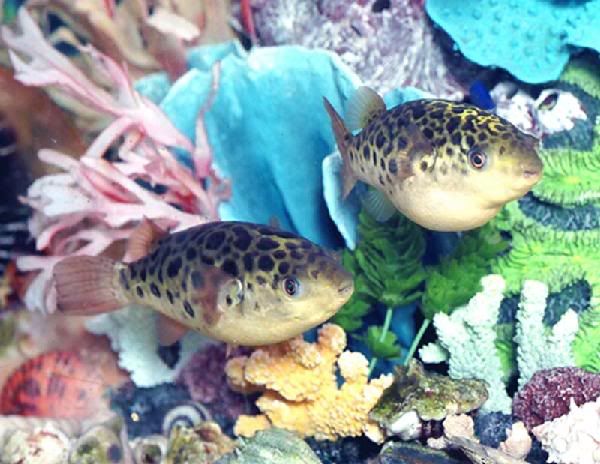
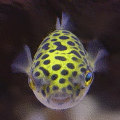
Why do PP's GSPs look yellowish/aged and the GSP shown in the video kept their youthful color? Is that related to keeping some GSP in marine condition and the other one in BW?
My Puffers: Puffers I have kept: T lineatus T miurus A modestus T biocellatus C valentini C coranata C papuan C lorteti DPs suvattii burrfish T niphobles
Mine are in marine but it is hard to tell actually what size/age the one is in that vid.
It may not be an adult yet. The one on the right in my pic, always had a brighter head. Most puffer's juvie colors dull with age.
You are getting sleepy... you only hear the sound of my voice... you must do water changes... water changes... water changes... water changes...
My Puffers: Puffers I have kept: T lineatus T miurus A modestus T biocellatus C valentini C coranata C papuan C lorteti DPs suvattii burrfish T niphobles
My mom took over one of my tanks at home because I found a surrender adult GSP at an lfs that didn't know what to do with him. My mom fell in love with him! He's about 6 inches I'd say and looks the same as my baby GSP color-wise. They're both in full marine and the adult is around 4 years old I think...that's what the lfs said anyway.
To puff, or not to puff...
"...Ok you caught me, I'm smuggling another tank into my room...yes, for another fish."
Puffers modify their colors by by the surroundings - regardless of age. Substrate, background, in-tank decor, and lighting arr play big to huge roles. Change any one of those and they fish changes either in look on film or in person or even in reality.
the GSP's fluorescent cap is diagnostic of the fish, but it must be at least reasonably healthy to show it. I hve oftn suspected in co-oused GSPs,the brightest cap is either male or dominent or both, but I have not kept enough GSPs together to be at all sure of that.
Fahaka's color is even more sensitive and responsive to surroundings than GSPs IME.
My GSP changes colour as the day progresses. In the morning he's yellow with spots and a white belly then at night he's more green with spots and a darker belly. I hope this is normal.
I believe it is very normal IMO, my GSP changes throughout the day. Sometimes he's brownish when he's near my driftwood. I've seen him bright fluorescent green, or a deep dark green, greenish brown, etc.. He's just about anything between yellow, green and greenish-brown on his back, and brown to grey to white on his stomach. I check the water regularly, its within recommended parameters. I perform regular water changes. The current tank has been up about six months, and I keep the temperature all but a constant 80F.
I've heard that a gsp may become dark, almost a black when water quality becomes less favorable for the fish.. But they may also change their color to suit their surroundings or mood. Puffers are quite intelligent fish, when mine gets bored with food he tends to turn dark as soon as he realizes what I gave him. He also tends to become dark near feeding time or when hungry, and after his tummy is full, he's usually fluorescent in color. Surroundings and lighting seem to effect color/mood as well. At the time of writing this, he's green and white, but a little dull. Last night before I turned out the light, he was in the driftwood and almost the same color brown as the wood, it took me a moment to find him in the tank.
I thought the difference in color of the adults GSPs was due to keep them in brackish or marine. My GSP is <2'', is there any trouble keeping him in mid BW (1.011)?
My GSP is about 6CM and in 1.013 SG. He's been in Mid-Brackish for some time now.. I've heard no problems keeping any size puffer in up to marine conditions. Just that larger puffers are recommended to be kept in higher salinities.
My Puffers: I currently have one gsp just a little guy 2.5 inch 30 gal. long one betta crown tail in 10 gal. planted :) very happy 36 gal. planted bow front betta half moon 6 platies 7 tetra neon.planted
My gsp is around 2-2.5 inch and Hes in full marine. He has great great color and a white belly. But when he sleeps his spots fade almost completely away to match the light sand.
The GSPs need to be mid-brackish. When you go to full marine is personal option.in my experience (IME). Full marine is cheaper and easier to get and hold high-quality water than mid BW, but it does involve additional equipment - which you will be using for 10-15 years,so it is worth the investment to me.
My Puffers: 55g (2) GSP, (2) Maroon Clownfish, (1) blue damsel, And some soft corals and 1 Nem 45g FW community 20g snail and shrimp breeding tank for puffers
I heard that in juveniles their colors aren't as bright then as they become adults it gets brighter but, I will agree to the dominance theory too. I have 3 and the largest is always florescent the middle oldest is very bright but with a little more grey on his side and the baby one shows the least color but can become bright and dominant during the feeding time giving the big ones a run. little ones like a dark green while the others brights mostly. My LFS store said they had two givin to them recently and one stayed fresh and the other marine and the guy I spoke to said he was amazed at how much more florescent looking the one was in marine conditions almost instantly as they were both still youngins. In turn i already am heading for the full marine conditions now and just added my argonite sand which was dam exspesive $65 bucks for two 30lb bags now to take all those tacky freshwater looking decor out and start adding rock I cant wait. I live in MI so if you kno where to get cheap Live/dead rock holla at me.
"DREAM AS IF YOU'LL LIVE FOREVER, LIVE AS IF YOU'L DIE TODAY' -JAMES DEAN
My Puffers: Puffers I have kept: T lineatus T miurus A modestus T biocellatus C valentini C coranata C papuan C lorteti DPs suvattii burrfish T niphobles