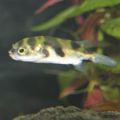
Some days ago I started a conversation with a man who lives in Saigon (Vietnam). He took some pictures of F8 puffers in their natural habitat. So I wrote some messages to him asking about it. So I will post what he answer about the biotope, plants, water chemistry etc. because I deleted the first messages I wrote (only saved the answers), then you’ll have the original messages.
Pierre Siquet said: So you can see about the type of environment.


We caught them just in front of my house in almost fresh water (about less than a gram of salt per liter). pH about 6.8-7, hardness must also be pretty low (KH probably under 4, not checked yet, but my guess must be reliable). Temperature from 27-30º C.
Water has medium current up to about 0.5 meters/second, visibility is extremely low in rainy season (about 3-4 cm) and still low in dry season (50cm). There is also about 2-3.5 meters tides twice a day. No plant, just mud (clay). Very flat. Only when the water is very high it reaches some aerial plants (no water plant around). Only plants in the river are Water hyacinths (99%) and Pistia (1%).
In my tank they have been eating all.... even making many holes in the plants to catch the snails.
Me: So, still talking about tetraodon biocellatus biotope, you just saw them in an almost freshwater river (or wetland?) with some nymphaeas and pistias. Didn't you notice any kind of wood or rocks underwater? Because when you set up a tank for them, you have to provide a complex environment to avoid them getting bored (when they start to pace up and down the glass)... that's why I'm asking you if you saw a complex environment where you saw them? By the way, did you find them in anywhere else?
If you were me, how would you aquascape the tank for them? What kind of rock, sand, gravel, plants, and wood would you use to decorate the tank?
While you have them in front of your house, I pay dearly for them and they only appear once in a while in the local fish stores near me. So I want to offer them the best quality of life as I can. I also love those fish!
PS: Hi Fernando,
It is deadly boring environment. I can even attach an underwater 3D picture from the sonar (ultra sound) of my boat. You see as top view.

Very flat, nearly no object. The object (coconut log on the right) seen on the picture was not there at that time. On the left, they are the trees at high tide. Unless you see the ground, it is desperately flat.
I only found 2 or 3 of them at this place, unless I never found them anywhere else. T. nigroviridis are more common closer to the sea.
For the tank, you will never want to have it looking as the nature (brown water and muddy ground), so when I moved them in my glass tank, they were in a normal wood/rock/plants environment.
Me: Thanks Pierre for that great information... so the only decoration choice we have to offer them is the regular way in aquascaping the tank: using branches, rocks and plants. Tetraodon biocellatus biotope is a big no-no, right?
PS: Well, I do not think you will be happy having mud and muddy water and nothing else in your tank (its biotope here).... so you can use a classic planted tank. They are very curious fish, so I am sure they will enjoy to swim around. They have a very interesting behavior.
Me: Now I'm writting to ask you if I can post our conversation in a forum where people discuss about puffers. I guess they will enjoy it.
This is the link of the forum:
http://www.thepufferforum.com
Pierre Siquet: Hi Fernando,
It is fine for me. You can also add the pictures.
Best
Pierre