Arothron manilensis in a brackish tank...

Arothron manilensis in a brackish tank...
I don't know if anyone is interested in this information, but I kept a small Arothron manilensis (grew from 2" to about 5") in a brackish tank with a green "freshwater" moray for over a year back in the early 90's. The salinity was light to heavily brackish, but variety was the norm and exacting was not. Has anyone ever heard that this fish is a estuarine species?
-
Pufferpunk

- Queen Admin
- Posts: 32979
- Joined: Tue May 31, 2005 11:06 am
- Gender: Female
- My Puffers: Puffers I have kept:
T lineatus
T miurus
A modestus
T biocellatus
C valentini
C coranata
C papuan
C lorteti
DPs
suvattii
burrfish
T niphobles - Location (country): USA, Greenville, SC
- Location: Greenville, SC
- Contact:
Re: Arothron manilensis in a brackish tank...
What happened to him after that? They are known to "visit" BW but should not be kept there for long-term.
You are getting sleepy... you only hear the sound of my voice... you must do water changes... water changes... water changes... water changes...
"The solution to pollution is dilution!"
"The solution to pollution is dilution!"
-
Corvus

- Mentor
- Posts: 1405
- Joined: Mon Dec 04, 2006 10:35 am
- Gender: Male
- Location: Planet earth; mostly Germany recently
Re: Arothron manilensis in a brackish tank...
It's known that this species travels into estuaries quite often. Many literature references state this and many specimens in trade come from estuaries or river mouths and some are imported as "freshwater" from time to time. For long term care heavy brackish to marine is recommended, exact numbers are not needed for the fish, but can help to keep the beneficial bacteria colonies working, higher salinities also help with skimming. Long term care in freshwater or very light brackish water can result in a weak immune system. Same can be said about all species of so called "freshwater" morays. Do you have pictures?
Give a man a fish, and he'll eat for a day. Give a fish a man, and he'll eat for weeks.
Re: Arothron manilensis in a brackish tank...
Cool...I have always wondered about that. After that year or so, I moved, broke the tank down and took him back to the LFS where I worked at the time. He went into a salt tank...the moray did not. Getting rid of that moray was one of my biggest regrets ever...it looked like velvet, and was so deep green. Blind as a bat, though. I do not have any pictures, unfortunately. I have seen many "freshwater" morays over the years, but always the ones they call snowflakes...never another green one. Someone told me once that juvenile Gynothorax funebris are estuarine...but I cannot verify that that was what I had....sounds far fetched to me.Corvus wrote:It's known that this species travels into estuaries quite often. Many literature references state this and many specimens in trade come from estuaries or river mouths and some are imported as "freshwater" from time to time. For long term care heavy brackish to marine is recommended, exact numbers are not needed for the fish, but can help to keep the beneficial bacteria colonies working, higher salinities also help with skimming. Long term care in freshwater or very light brackish water can result in a weak immune system. Same can be said about all species of so called "freshwater" morays. Do you have pictures?
-
Corvus
- Mentor
- Posts: 1405
- Joined: Mon Dec 04, 2006 10:35 am
- Gender: Male
- Location: Planet earth; mostly Germany recently
Re: Arothron manilensis in a brackish tank...
Echidna rhodochilus can be green (or brown), but always has a conspicuous white blotch at the mouth. It is often caught in estuaries, nonetheless does best at high brackish to marine:
http://www.jjphoto.dk/fish_archive/aqua ... ilus_x.jpg
http://www.fishbase.se/images/species/Ecrho_u0.jpg
Beware, most other online pictures of this species show Gymnothorax tile, the standard "freshwater snowflake moray".
The green moray G. funebris can enter brackish waters at any ages, but they will not survive low salinities for long. Interestingly juvenile G. funebris are clearly brown during the day and only green at night. In addition, they are very fast growers and extremely aggressive, have eaten black tip sharks in a large show tank over here. I'm confident you'd be sure if you had this species.
http://www.jjphoto.dk/fish_archive/aqua ... ilus_x.jpg

http://www.fishbase.se/images/species/Ecrho_u0.jpg
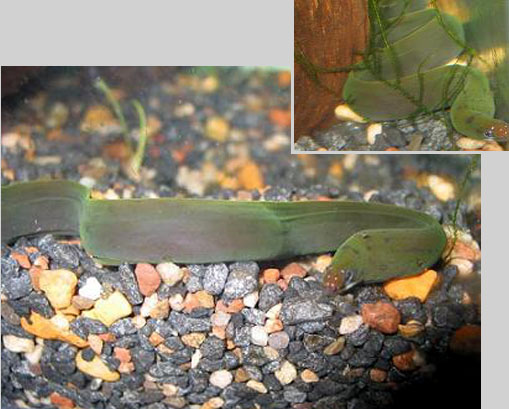
Beware, most other online pictures of this species show Gymnothorax tile, the standard "freshwater snowflake moray".
The green moray G. funebris can enter brackish waters at any ages, but they will not survive low salinities for long. Interestingly juvenile G. funebris are clearly brown during the day and only green at night. In addition, they are very fast growers and extremely aggressive, have eaten black tip sharks in a large show tank over here. I'm confident you'd be sure if you had this species.
Give a man a fish, and he'll eat for a day. Give a fish a man, and he'll eat for weeks.
-
Corvus
- Mentor
- Posts: 1405
- Joined: Mon Dec 04, 2006 10:35 am
- Gender: Male
- Location: Planet earth; mostly Germany recently
Re: Arothron manilensis in a brackish tank...

Give a man a fish, and he'll eat for a day. Give a fish a man, and he'll eat for weeks.
-
edmlfc1

- Mbu Puffer
- Posts: 2011
- Joined: Sun Sep 09, 2007 5:03 pm
- My Puffers: Elvis (Stars & Stripes) R.I.P. 9/11/11
125G:Fahaka (Annabelle) - Location (country): U.S.A.
- Location: Texas
Re: Arothron manilensis in a brackish tank...
That's one beatuiful eel.Corvus wrote:Here's another real E. rhodochilus:
http://azumanettaigyo.com/02tsuhan/Othe ... chilus.jpg

Need to know what kind of puffer you have? Click on Puffer ID.....Puffer ID: ug.php/v/PufferPedia/
What to feed your puffer? Click on Feeding......
Feeding: library/feeding/feeding-your-puffers/
Have a GSP, need more information......Click on GSP Article.....
GSP Article: library/puffers-in-focus/an-introductio ... d-puffers/
What to feed your puffer? Click on Feeding......
Feeding: library/feeding/feeding-your-puffers/
Have a GSP, need more information......Click on GSP Article.....
GSP Article: library/puffers-in-focus/an-introductio ... d-puffers/