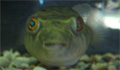
I just bought this little guy about a week ago. From what I understand, this particular kind of fish is supposed to be aggressive, but so far, the only fish he has even remotely been pissed at was the Beta, due to his fins (I have since moved Broomstick out of that tank).
My puffer has been living very comfortably with 3 other fish since then: a Bristlenose Pleco, a Golden Wonder Killie, and a Flying Fox. The fox has been the big boss of the tank, as he's already about 4" compared to the puffers puny 1 1/2". I've seen the Fox chase the Puffer out of his area several times. The Killie is about 2" and is too fast for the puffer to really catch. Of course, the Pleco keeps out of sight most of the time, he's only about 1 1/2" also.
My puffer survives on a diet of Garden Snails, which my generous roommate provided (groan) and also beef heart and blood worms (especially blood worms, he goes nuts!). So far, the Red Line has been quite hardy and fairly gregarious. As he grows, I'll be sure to post more about his habits and attitude toward the other fish in the tank.
Red Line/Red Band puffer
Red Line/Red Band puffer
You do not have the required permissions to view the files attached to this post.
Re: Red Line/Red Band puffer
I think that puffer is high end brackish, although not an awful lot is known about them at the moment. How big is the tank you have them all in?
Re: Red Line/Red Band puffer
The tank is a 10 gallon and it was sold as a freshwater fish. I don't know what signs to look for if the water is having a bad effect on him, but he has a healthy diet, swims very well, and still has plenty of room.
I know 10 is kind of small, but I'll eventually be graduating up to a 50 or 60.
I know 10 is kind of small, but I'll eventually be graduating up to a 50 or 60.
-
nmonks
- Mentor
- Posts: 364
- Joined: Wed May 24, 2006 8:33 am
- My Puffers: Carinotetraodon irrubesco
Colomesus asellus - Contact:
Re: Red Line/Red Band puffer
The red-line puffer is Tetraodon erythrotaenia, a brackish water species sometimes found in freshwater creeks. It's primarily a resident of mangroves, but if your specimen is happy in freshwater, I'd probably not fret too much in the short term. Once you get a bigger tank, that's the time to migrate to at least slightly brackish conditions. Not especially large (around 7 cm) but it is known to be a "biter" so probably best kept on its own. A 20-gallon tank would be ample.
I've never seen these fish traded so they're not included in my brackish book, but they are mentioned in the Aqualog puffer book if you want more details.
Cheers, Neale
I've never seen these fish traded so they're not included in my brackish book, but they are mentioned in the Aqualog puffer book if you want more details.
Cheers, Neale
-
Pufferpunk

- Queen Admin
- Posts: 32980
- Joined: Tue May 31, 2005 11:06 am
- Gender: Female
- My Puffers: Puffers I have kept:
T lineatus
T miurus
A modestus
T biocellatus
C valentini
C coranata
C papuan
C lorteti
DPs
suvattii
burrfish
T niphobles - Location (country): USA, Greenville, SC
- Location: Greenville, SC
- Contact:
Re: Red Line/Red Band puffer
I suggest against feeding beefheart to anything other than a pirahana.
You are getting sleepy... you only hear the sound of my voice... you must do water changes... water changes... water changes... water changes...
"The solution to pollution is dilution!"
"The solution to pollution is dilution!"
Re: Red Line/Red Band puffer
Why's that? I'm curious, my Killie loves it. Then again, he loves to eat anyway...Pufferpunk wrote:I suggest against feeding beefheart to anything other than a pirahana.
-
Nick
- Former Staff Member
- Posts: 3231
- Joined: Sun Oct 22, 2006 8:47 pm
- My Puffers: Mine:
GSPs - Shakespeare and Jillybean
F8 - Velvet
My fiance:
DP - Emma Goldman
Narrow Lined Puffer - Ulrike - Location (country): Northeastern USA
- Location: Middletown, CT
- Contact:
Re: Red Line/Red Band puffer
Most fish probably don't have the digestive capacity evolved to break down mammal fats or proteins efficiently, so it's a wasteful food.
No matter how magnificent your successes or devastating your failures, the worlds' approximately 5 billion impoverished people could not possibly care less.
-
Pufferpunk
- Queen Admin
- Posts: 32980
- Joined: Tue May 31, 2005 11:06 am
- Gender: Female
- My Puffers: Puffers I have kept:
T lineatus
T miurus
A modestus
T biocellatus
C valentini
C coranata
C papuan
C lorteti
DPs
suvattii
burrfish
T niphobles - Location (country): USA, Greenville, SC
- Location: Greenville, SC
- Contact:
Re: Red Line/Red Band puffer
Yeah... my dog loves rabbit poo--doesn't mean I should feed it to him.xcalibur wrote:Why's that? I'm curious, my Killie loves it. Then again, he loves to eat anyway...

You are getting sleepy... you only hear the sound of my voice... you must do water changes... water changes... water changes... water changes...
"The solution to pollution is dilution!"
"The solution to pollution is dilution!"
-
nmonks
- Mentor
- Posts: 364
- Joined: Wed May 24, 2006 8:33 am
- My Puffers: Carinotetraodon irrubesco
Colomesus asellus - Contact:
Re: Red Line/Red Band puffer
The main problem with feeding mammal or bird meats to fish is that the striated muscles of mammals and birds both contain lipids that are oils at "warm blooded" temperatures, but congeal into fats at "cold blooded" temperatures. Animals that haven't adapted to handling large amounts of solid fats can develop problems over time if they eat a fatty diet. The details aren't well known to me, but the general idea is that "pipes" inside the body such as capillaries can get blocked with lumps of fat, leading to organ damage.
Beefheart is cardiac muscle, which means it lacks fat. Therefore it is a safe food to use for fish. Historically it was very widely used to feed fish that wouldn't take dried foods, for example wild caught discus. Back when I started keeping fish, beefheart was one of the few widely available foods that discus would take. As the range of wet-frozen seafood and invertebrates has increased, the need to use beefheart has diminished. It's still available though, and while it probably doesn't have the perfect balance of vitamins and minerals, there's nothing wrong with using beefheart as an occasional treat.
Some aquarists (including, for example, Bob Fenner) have argued that marine fish are best fed on foods made from marine animals and plants. This rather contrasts with the wisdom around up to the 1980s, when it was often said that to avoid problems with parasites, you were best feeding marine animals to freshwater fish, and freshwater animals to marine fish. Bob's work with species such as lionfish has revealed that at least some freshwater prey animals (cyprinids, specifically) contains substances, including lipids and thiaminase, harmful to marine predators. On the other hand, home-bred livebearers such as mollies are -- because they lack thiaminase and are low in lipid content -- the only safe feeder fish for either marine or freshwater predators that will not take dead or invertebrate foods.
So you have to be intelligent about making choices. Bob's basic argument is a sound one: if you're keeping a marine fish, try and source marine foods, but there's some degree of nuance to the argument as well, where other issues, such as thiaminase, come into place. Thiaminase is an enzyme that destroys vitamin B1; it is common in a wide range of seafood in particular crustaceans and certain molluscs, including mussels. It isn't present in squid or cockles though. So while shrimps and mussels are good food for puffers, neither should be staples, and your puffers should be fed other foods as well, including thiaminase-free seafood and those freshwater/terrestrial foods that don't contain it either, such as pond snails and earthworms.
(The next issue of Conscientious Aquarist contains an excellent article on thiaminase, listing the foods high and low in this dangerous substance. It's harmfulness is well known to reptile-keepers, but for some reason has been overlooked by aquarists for a long time. At least some "mystery deaths" may well come down to chronic vitamin B1 deficiency. To read Conscientious Aquarist online, stop by Wet Web Media some time around the end of this month, early February.)
Curiously, there's little evidence freshwater or brackish water fish are harmed by being fed marine foods. Indeed, virtually all flake foods are based on marine proteins, so keeping your freshwater fish on a freshwater protein diet would be challenging. Broadly speaking, the main issue with freshwater fish is to identify which species are primarily or extensively herbivorous, and make sure they have a low protein, high fibre diet suited to their needs. Many catfish, cichlids, barbs and characins fall into this category, and in extreme cases, as with Panaque catfish, goldfish, mollies or Tropheus cichlids, excessive use of "meaty" foods can cause real problems.
Cheers, Neale
Beefheart is cardiac muscle, which means it lacks fat. Therefore it is a safe food to use for fish. Historically it was very widely used to feed fish that wouldn't take dried foods, for example wild caught discus. Back when I started keeping fish, beefheart was one of the few widely available foods that discus would take. As the range of wet-frozen seafood and invertebrates has increased, the need to use beefheart has diminished. It's still available though, and while it probably doesn't have the perfect balance of vitamins and minerals, there's nothing wrong with using beefheart as an occasional treat.
Some aquarists (including, for example, Bob Fenner) have argued that marine fish are best fed on foods made from marine animals and plants. This rather contrasts with the wisdom around up to the 1980s, when it was often said that to avoid problems with parasites, you were best feeding marine animals to freshwater fish, and freshwater animals to marine fish. Bob's work with species such as lionfish has revealed that at least some freshwater prey animals (cyprinids, specifically) contains substances, including lipids and thiaminase, harmful to marine predators. On the other hand, home-bred livebearers such as mollies are -- because they lack thiaminase and are low in lipid content -- the only safe feeder fish for either marine or freshwater predators that will not take dead or invertebrate foods.
So you have to be intelligent about making choices. Bob's basic argument is a sound one: if you're keeping a marine fish, try and source marine foods, but there's some degree of nuance to the argument as well, where other issues, such as thiaminase, come into place. Thiaminase is an enzyme that destroys vitamin B1; it is common in a wide range of seafood in particular crustaceans and certain molluscs, including mussels. It isn't present in squid or cockles though. So while shrimps and mussels are good food for puffers, neither should be staples, and your puffers should be fed other foods as well, including thiaminase-free seafood and those freshwater/terrestrial foods that don't contain it either, such as pond snails and earthworms.
(The next issue of Conscientious Aquarist contains an excellent article on thiaminase, listing the foods high and low in this dangerous substance. It's harmfulness is well known to reptile-keepers, but for some reason has been overlooked by aquarists for a long time. At least some "mystery deaths" may well come down to chronic vitamin B1 deficiency. To read Conscientious Aquarist online, stop by Wet Web Media some time around the end of this month, early February.)
Curiously, there's little evidence freshwater or brackish water fish are harmed by being fed marine foods. Indeed, virtually all flake foods are based on marine proteins, so keeping your freshwater fish on a freshwater protein diet would be challenging. Broadly speaking, the main issue with freshwater fish is to identify which species are primarily or extensively herbivorous, and make sure they have a low protein, high fibre diet suited to their needs. Many catfish, cichlids, barbs and characins fall into this category, and in extreme cases, as with Panaque catfish, goldfish, mollies or Tropheus cichlids, excessive use of "meaty" foods can cause real problems.
Cheers, Neale
Pufferpunk wrote:I suggest against feeding beefheart to anything other than a pirahana.
Re: Red Line/Red Band puffer
i've noticed something odd.
Along his brow ridge, he has a yellow stripe. a moment ago, it wasn't there, but now, it's back. is it normal for a fish to lose its color like that? there wasnt anything particularly stressfull happening
Along his brow ridge, he has a yellow stripe. a moment ago, it wasn't there, but now, it's back. is it normal for a fish to lose its color like that? there wasnt anything particularly stressfull happening
-
edmlfc1

- Mbu Puffer
- Posts: 2011
- Joined: Sun Sep 09, 2007 5:03 pm
- My Puffers: Elvis (Stars & Stripes) R.I.P. 9/11/11
125G:Fahaka (Annabelle) - Location (country): U.S.A.
- Location: Texas
Re: Red Line/Red Band puffer
Have you tested your water? Is there amm. or nitrites showing? You may need to do a water change.
Need to know what kind of puffer you have? Click on Puffer ID.....Puffer ID: ug.php/v/PufferPedia/
What to feed your puffer? Click on Feeding......
Feeding: library/feeding/feeding-your-puffers/
Have a GSP, need more information......Click on GSP Article.....
GSP Article: library/puffers-in-focus/an-introductio ... d-puffers/
What to feed your puffer? Click on Feeding......
Feeding: library/feeding/feeding-your-puffers/
Have a GSP, need more information......Click on GSP Article.....
GSP Article: library/puffers-in-focus/an-introductio ... d-puffers/
-
apachepufferman
- Green Spotted Puffer
- Posts: 276
- Joined: Wed Jun 25, 2008 11:28 pm
- My Puffers: 1 fahaka 2 gsp
1 arrowhead 4 dwarfs
1 sap and thats just the puffers!!! So i'm a little fish crazy - Location: boise id
Re: Red Line/Red Band puffer
both of mine have the yellow head and they didn't actually show this color until they were happy and settled. All of my puffers change their colors, stripes and markings depending on mood and time of day. So I wouldn't get to upset over it.
Also i keep mine at as near to freshwater as you can get; 1 cup marine salt per 25 gallons. They were stressed in pure FW but when I added this amount of salt over a couple weeks they seemed to brighten up.
I also have a guppy infestation in that tank and they seem to be big happy family.
Also i keep mine at as near to freshwater as you can get; 1 cup marine salt per 25 gallons. They were stressed in pure FW but when I added this amount of salt over a couple weeks they seemed to brighten up.
I also have a guppy infestation in that tank and they seem to be big happy family.
adam
Re: Red Line/Red Band puffer
it seems i've run into a bit of a hitch. this may be more of a general fish question, but since it pertains to my puffer, what the hell...
my Killie seems to be the only one who recognises that i'm the food provider, my puffer is still very VERY leery of me. when i feed my fish, the killie usually gobbles up all the food. is there any way to dissuade him from doing that or maybe something i'm missing in the process? the killie goes after anything that is dropped in, btw, its not just bloodworms
my Killie seems to be the only one who recognises that i'm the food provider, my puffer is still very VERY leery of me. when i feed my fish, the killie usually gobbles up all the food. is there any way to dissuade him from doing that or maybe something i'm missing in the process? the killie goes after anything that is dropped in, btw, its not just bloodworms
-
edmlfc1
- Mbu Puffer
- Posts: 2011
- Joined: Sun Sep 09, 2007 5:03 pm
- My Puffers: Elvis (Stars & Stripes) R.I.P. 9/11/11
125G:Fahaka (Annabelle) - Location (country): U.S.A.
- Location: Texas
Re: Red Line/Red Band puffer
All you can do is give it time to adjust. Once it knows you are the one that feeds it, it will beg daily for food.  At that time you must resist the need to overfeed.
At that time you must resist the need to overfeed.Need to know what kind of puffer you have? Click on Puffer ID.....Puffer ID: ug.php/v/PufferPedia/
What to feed your puffer? Click on Feeding......
Feeding: library/feeding/feeding-your-puffers/
Have a GSP, need more information......Click on GSP Article.....
GSP Article: library/puffers-in-focus/an-introductio ... d-puffers/
What to feed your puffer? Click on Feeding......
Feeding: library/feeding/feeding-your-puffers/
Have a GSP, need more information......Click on GSP Article.....
GSP Article: library/puffers-in-focus/an-introductio ... d-puffers/
-
apachepufferman
- Green Spotted Puffer
- Posts: 276
- Joined: Wed Jun 25, 2008 11:28 pm
- My Puffers: 1 fahaka 2 gsp
1 arrowhead 4 dwarfs
1 sap and thats just the puffers!!! So i'm a little fish crazy - Location: boise id
Re: Red Line/Red Band puffer
my first red line didn't seem to eat for two weeks. I was getting worried and now its right there when i start feeding.
adam