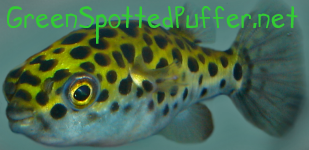
Hi, I have been researching dwarf puffers for about a month now. I have a 10g tank all setup and my husband found these guys at a lfs labeled "puffers". I'm not sure what kind of puffers he got. Can someone please help identify these guys and give me some info on them if they are not dp?
No, he just brought them home today. I'm not dure that the really skinny one is going to make it. What should I do now? I have a thirty gallon I cvan put him in after I sell my angel pair, so tank size isn't an issue...I'm just not so sure about adding salt to the water.
Well the good thing is you needn't rush because GSPs start off in fresh when they're young anyway and gradually move towards the ocean as they get older. So you have to mimic this in the aquarium as bet you can. The best way is like it says in that article:
"I suggest keeping GSPs in low-end brackish water when juvenile <2", (in a specific gravity, or SG of 1.005-10, at 2-4", medium BW (SG 1.010-15) and adult >4″ SW (SG 1.018-22). You must use marine salt. You will need a hydrometer to measure the salinity. It takes a cup of salt/5 gal of water to raise the SG .005. If the puffer you purchase is in FW at the store, then you should start out your tank in FW and raise the SG .002/week, until you reach the desired SG. This is so you don’t destroy the good nitrifying bacteria as you add salt. SW bacteria are different than FW, so you need time for the SW bacteria to develop as the FW bacteria dies off slowly."
You may want to go to the store tomorrow and find out whether they already had it in brackish. But if they don't even know what puffer it was then I doubt they did. Basically you will just need marine salt and a hydrometer, then just follow the instructions above. And that 30 gallon will be much better for just one of them. You will need to buy a bigger one for the both of them after a while unless you decide to keep them separately, but the one in the 10 gal will still need an upgrade at some point. And don't forget to buy some medication for IPs for that skinny one and make sure they are both eating well, although that can take a few days sometimes. Don't be scared, just read that article really thoroughly and then just go for it!
Thank you so much Riggers!!! My husband is going to pick up some instant ocean and a hydrometer tomorrow. Hopefully, I will be able to figure it all out. Thanks again.
Lisa
My Puffers: Puffers I have kept: T lineatus T miurus A modestus T biocellatus C valentini C coranata C papuan C lorteti DPs suvattii burrfish T niphobles
Your #1 concewrn at this moment is the internal parasites your puffer is horribly suffering from. With the amount of snails in that pic, that puffer should be nice & fat. Read the article on treating IPs in our Library & treat all the fish that puffer is with.
You are getting sleepy... you only hear the sound of my voice... you must do water changes... water changes... water changes... water changes...
OK, the really skinny puffer dies a couple of hours after being put into the tank. The other one seems to be doing ok for now. He is very fat and is swimming all over the place. Should he still be treated? Now I have to sell my angel pair so this guy will have a 30g tank to go into...assuming that will be large enough when he is grown. Thanks for all your help!
Lisa
My Puffers: Puffers I have kept: T lineatus T miurus A modestus T biocellatus C valentini C coranata C papuan C lorteti DPs suvattii burrfish T niphobles
Before adding salt you should take out any fragile live plants, the salt will kill them. The snails will all die off too, so if you want to save them for breeding more puffer food you should set up a separate tank.
I'd agree with PP and say your #1 priority should be treating the IPs.
How many puffers did you buy? 10gallons isn't anywhere near the amount of space these guys will need. 30gallons each is the absolute minimum. So you'll want to look into a much larger tank.
My Puffers: Puffers I have kept: T lineatus T miurus A modestus T biocellatus C valentini C coranata C papuan C lorteti DPs suvattii burrfish T niphobles