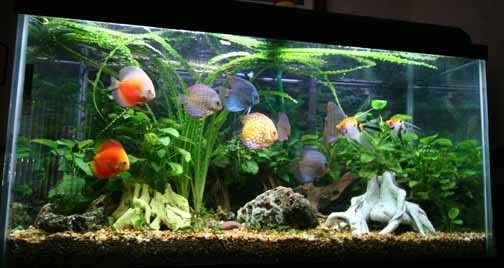
What should I consider when thinking of a planted tank, and, how do you keep a planted tank alive (ie maintenance, start up supplies, etc). I know nothing of this at all, so feel free to comment and suggest away =)
I'm going to assume that you want a low- to medium-tech tank. High-tech is incredibly expensive and complex. I run medium-tech, myself. Here's what you need to consider:
-Light - how much, what kind?
-Fertilizers - what kind? Carbon - liquid, DIY, or none? Substrate - inert or fertilizing?
-Aquascaping - what style? What materials?
-Plants - what kind can I have with the technology I'm using?
Light is the first thing to think about. It can get pretty expensive, but you can generally get away with whatever your tank already provides. Check the bulbs and see how many watts each one has; divide by the number of gallons. That's your "watts per gallon" (WPG). You also need to consider how deep your tank is. It's counterintuitive, but you need fewer WPG in a deeper tank. In a typical 20g, 1WPG is pretty low, and 2.5WPG is on the high end of medium. If you don't have enough light, you'll need to either buy new bulbs or look into a DIY solution. I went with DIY.
Fertilizers are the next thing. In a small tank like your 20g, and if you're not going high-tech, I think that what's easiest is to buy premade liquid fertilizers and use the recommended dosage as you see fit; you'll be able to work this out over time based on your tank's needs and the local water. I use Seachem Flourish's whole line - macronutrients (nitrogen, potassium, phosphorus), micronutrients (the basic regular Flourish, plus occasionally iron), and carbon (Excel). I follow the recommended dosage and it's working fine for me and my local water, with adjustments only for tank stocking levels and nitrogen dosing.
Carbon can come in a liquid form, like the Excel that I use, or it can come in gas form. You can build or buy really complicated pressure systems for gas, but if you're just starting out and don't plan to go high-tech, you don't need or want this. You can do gas carbon with a DIY system made from empty soda bottles, airline, and a yeast/sugar/water mixture. I've done it before, and it was tricky to get started, but fairly simple overall. Liquid is definitely simplest; you get a bottle of the stuff and pour in the correct dosage every day.
I like sand for my substrate. One of my tanks has Seachem flourite sand for planted tanks; the other one has pool filter sand. They're both fertilized with Flourish gravel tabs (I don't know why they're called gravel tabs when you can use them for any substrate). You can also try earthy substrates like Eco-Complete and other premade planted tank substrates, which are fertilized, or you can do a DIY substrate using various complicated things like kitty litter that I don't really understand. I haven't looked into those, but you might try it. I don't recommend gravel.
Keep in mind that the wrong balance of light, carbon, and other fertilization can cause issues - either slow growth or algae. Read up on this!
Aquascaping is fun. There's some distinct styles, like Dutch and "nature." I like Dutch best.

You can get really into aquascaping and take a mathematical approach, or you can just put things together in a way that looks/feels right. Look at other tanks for inspiration. Think about driftwood and stone ("hardscape"), substrate, and plants. Shapes, colors, and empty space are all important. This is the artistic part!
Finally, plants! In a low- or medium-tech tank, you can actually have a pretty wide variety. Low-tech is kind of limited; things really opened up for me when I did my DIY light upgrade and went medium. You'll want to look up plants individually to see what their care requirements are, but a good starting point would be to look into mosses like java, ferns like Amazon and java, crypts, floaters like frogbit, anubias, swords, and a few stem plants like wisteria and water sprite. Avoid most things with red tones; leave those for the high-techers. Dark greens are usually safe, and some medium greens are easy too.
I got a lot of good, clear, solid info on planted tanks from the plantedtank.net guide, which cost me something like ten or twenty bucks and is an e-book that I have to access online.