Page 1 of 1
A. Melegaris & A. Nigropunctatus
Posted: Fri Nov 11, 2011 3:50 pm
by RVS
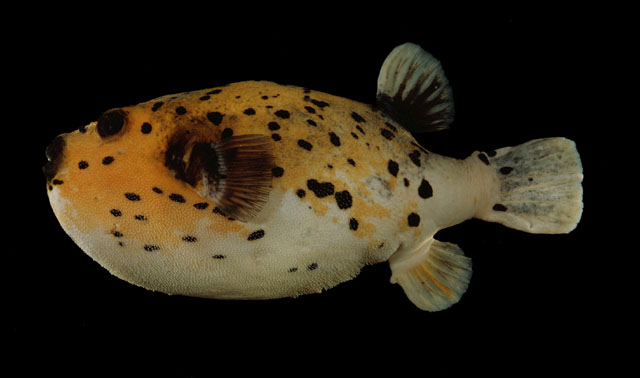
Hello! folks! I'm working on a study about Arotrhon genus and i´ve found that A. Melegaris & A. Nigropunctatus. have a very similar phase, gold or yellow..
Is there a way to difference A. Melegaris & A. Nigropunctatus yellow phase?
i mean, i don't want to confuse a 25" puffer with a 16" one

Re: A. Melegaris & A. Nigropunctatus
Posted: Sat Nov 12, 2011 4:09 am
by Corvus
study?
Yes, they can be told apart by body shape (A. meleagris is bulkier), relicts of black with white spots (only occuring on A. meleagris, this one has a lot of them
http://fishbase.org/images/species/Armel_u0.jpg), general coloration (A. nigropunctatus most often has a darker area around the snout and more spots,
http://fishbase.org/images/species/Arnig_ua.jpg). None of these characters is fail-safe, but in combination they work quite well.
Re: A. Melegaris & A. Nigropunctatus
Posted: Sat Nov 12, 2011 4:20 am
by Corvus
Also see
viewtopic.php?f=6&t=11780 and if you intend to do a real study be sure to get
http://www.jstor.org/pss/4064849 from your trusted library.
Re: A. Melegaris & A. Nigropunctatus
Posted: Sat Nov 12, 2011 12:13 pm
by RVS
Now i know why your nick says "mentor" you are cool dude!
Thank you a lot, i will start this study, more practical than theorical about the yellow morph of these 2 species... its always unclear the reason for this pigmentation phenomenon, some says its a color change, another says that is similar to albinism (born yellow, stay yellow)
what do you think?
Re: A. Melegaris & A. Nigropunctatus
Posted: Sat Nov 12, 2011 12:28 pm
by Corvus
The color change is a myth. See in the link above (
viewtopic.php?f=6&t=11780 or
viewtopic.php?f=6&t=26825&p=287991). This is simple xanthism which occurs in many fish (and other) species.
Re: A. Melegaris & A. Nigropunctatus
Posted: Sat Nov 12, 2011 12:52 pm
by RVS
Exactly, xanthism, thats the point of the study, related an based in an article that studies this phenomenon in the Aulostomus chinensis an the Aplodactylidae family, who presents the same pigmentation cells behavior...
Im still reading all the links you show me, and there some points that are interesting, like genome size and another possible indicators for sexual preference or external factors
but anyway i´ll need help to develop a turst document....