Page 1 of 2
Marine Velvet
Posted: Sun May 04, 2008 11:21 pm
by DRRT
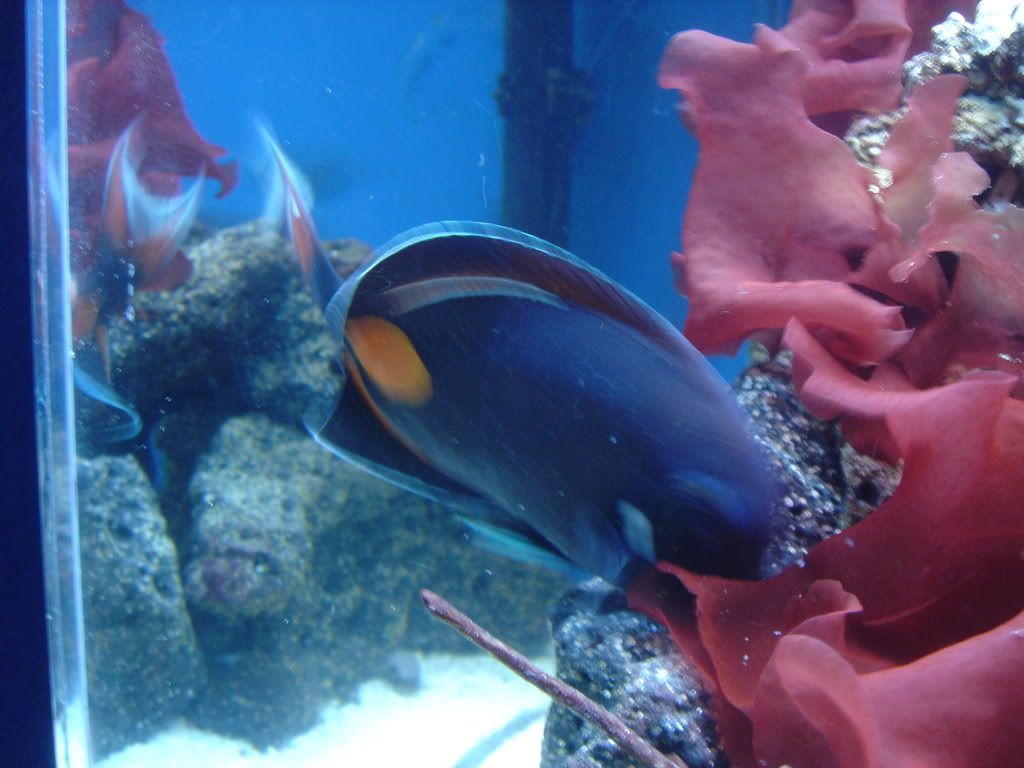
I have a 50g tank with 2 toby puffers, a blue hippo tang and an achilles tang. The last fish to have been added was the achilles tang, but that was in Aug of last year. The only other things in there are as follows (with when added in parenthesis):
hermit crabs (been there a long time)
coral banded shrimp (added in Dec)
burrowing snails (Dec)
mushrooms (~1 month ago)
red kelp (couple days after the shrooms)
a couple pieces of live rock (~2 weeks ago, came from a live rock only tank)
There have been no significant changes to the tank other than an increase in lighting from ~110 watts to ~188 watts with the addition of my new light fixture (added about 2 1/2 weeks ago). Today I added a Koralia 2 to increase water movement and thus airation.
pH 8.2 NH3 ~0 NO2 ~0 NO3 ~20 Ca ~480 ppm <----a bit high, but its been like that for about 3 months now
salinity ~1.023
I feed the fish every day and change 10g every week, usually sundays. I do not use additives other than various vitamins for the fish (Zoe, Zoecon, Vitamin C) and phytoplankton for the tiny feather dusters and shrooms.
The tank has been set up for sometime around 2 1/2 years and was cycled the newbie way with damsels. I have had ich before and some other deaths due to unknown causes with no symptoms. But this is the first outbreak of disease in the tank in over a year. The last fish to have died in the tank was a lemonpeel angel due to my error - I didn't turn on the air pump, thereby drasticly lowering the pH.
Both of the tangs are showing the sprinkling of white characteristic of marine velvet. The blue tang started showing it exactly one week ago and the achilles showed the next day. The achilles commonly visits the shrimp and has been cleaned before. The blue tang is currently in a 10g quarentine tank due to it being only 4 in long and can be housed in the QT. I have not started any dosing other than strictly following the recommended dosage for Vitamin C and monitoring the pH. The achilles seems to be too large for my QT and is still in the main tank receiving no extra attention other than visits to the shrimp. I have not observed either of the fish showing the other common signs of velvet like scratching. The puffers are showing no signs of being infected with velvet, but I understand that that doesn't mean they don't have it.
What is the best way to treat the velvet in the QT and potentially the main tank (which houses the inverts)?
As a side note, where did this come from?
Thank you in advance and I am perfectly willing to provide any additionaly info needed.
Re: Marine Velvet
Posted: Sun May 04, 2008 11:54 pm
by Pufferpunk
You might post this Q to Puffer Queen in her forum at Marine Depot. I can't be sure where the parasite came from. I'm pretty sure you need to QT everyone & treat w/copper. What dose of VC are you using?
Re: Marine Velvet
Posted: Mon May 05, 2008 12:18 am
by DRRT
Just the recommended dosage from the Kent VC. I only placed the tang in the QT yesterday and started dosage then. In a week I will slowly double the dosage so it can be more effective. There was a link to an article about VC here, and I am trying to follow that. I have noticed that the Velvet "looks" to have gone down on the tang in the QT, but that could be from lack of lighting. It also had cloudy eyes, which have already cleared up. The achilles now seems to have the worst of it. There is no way it can be properly maintained in my QT.
I just posted this at Marine Depot - Thanks.
Re: Marine Velvet
Posted: Mon May 05, 2008 12:36 am
by Nick
I have recently heard a several repeated doses of flubendiazole can be used to purge a SW tank and it's fish of velvet if snails and sensitive corals are removed, without the risks associated with copper and the massive daily water change procedures of quarantined fish. This seems to be a fairly new development, I wonder if pufferqueen has heard of trying this. I have been experimenting with flubendiazole a bit lately as it seems to be a very powerful anti protozoan medication in addition to its ability to kill certain worms; it removed what looked like fatal hole in the head from a large oscar.
Re: Marine Velvet
Posted: Mon May 05, 2008 2:08 am
by DRRT
Re: Marine Velvet
Posted: Mon May 05, 2008 2:29 am
by Pufferpunk
Sorry, it's just not clear enough to ID. If you are following my article, the Kent product will not contain enough VC. We're talking about MEGA dosing here! At the moment, I dose my 100g system with 9500mg (about 23ppm), 2x/day, to keep healthy zoas (they were melting before) & healthier corals.
Here is the article that describes some about how VC helps with fish health. Ignore the dosing chart, it's incorrect.
http://www.livingreefs.com/forums/saltw ... min-c.html
You should order some Sodium ascorbate or Calcium ascorbate from here:
http://www.i-herb.com.
Discount coupon code: FOR500
For every 100 gallons:
5 ppm ----- 1892 mg VC
10 ppm ---- 3785 mg VC
15 ppm ---- 5677 mg VC
20 ppm ---- 7570 mg VC
25 ppm ---- 9462 mg VC
30 ppm ---- 11355 mg VC
Be sure your pH is around 8.2 & your alk is around 9-10, before you start. Keep an eye on both (I test weekly, now that I notice no changes).
The method to be followed in all cases is as follows:
Day 1 : concentration of 5 ppm
Day 2 : concentration of 15 ppm
Day 3 : concentration of 30 ppm
Day 4 : concentration of 50 ppm
After day 4, continue treating with a concentration of 50 ppm for 10 more days to 30 more days, depending on the severity of what you are treating for.
The total treatment period is thus 14-30 days but can last longer if need be.
In real severe cases you may need to treat for an additional 7 days or more
During this entire period you should not be using activated carbon
During this entire period you should not be using any chemical filtration media either (e.g. resins or pads, SuperChem and the like).
The skimmer needs to continue to be in operation.
Note that when you use these kind of Vitamin C concentrations it really is of utmost importance that you monitor you pH and ensure that it does not suddenly drop.
Check the pH before you add the C but check a few minutes later also. If the pH is too low add a complete buffer immediately to re-establish your alkalinity and increase the pH of the water in the tank. This is very important indeed.
It is important too, to realize that your dKH must be in the 9 to 10 range to minimize the amount of cloudiness that will develop. It the dKH is high (e.g. 12 or more) you will initially have a lot more cloudiness. This will gradually disappear though as you continue the treatment.
Re: Marine Velvet
Posted: Mon May 05, 2008 6:43 am
by bonnie3188
Id say with two tangs in a 50g it was only going to be time before they contracted a disease. Blue tangs are especcially prone to ich and velvet, and an achilles tang in a 50g is never going to end up well.
Ive found puffers to be a lot more resilient to disease, and although the parasite will be in the water they might be fighting it off more effectively than the tangs.
Ive treated ich with copper with success, but if it's velvet then it will be a lot harder to treat. I once lost a longnose butterfly within hours of showing signs of velvet.
I would recommend buying a QT tank large enough to treat all the fish- including the puffers- because youre going to have to leave the main tank empty for 6-8 weeks if you want to completely eradicate the disease.
Good luck, if the tangs survive you really need to get them a bigger home.
Re: Marine Velvet - probably ich
Posted: Tue May 06, 2008 1:35 am
by DRRT
Sorry I couldn't get better pics. The fish never seems to stop.
The achilles is about 4 in long and is the largest fish in the tank, the blue being about 3 - 4 in. When they get bigger they will be moved to a 120, currently being used by my step-dad. When the time comes we will do a switch-a-roo, me getting his and he getting a really big one for his stuff.
I have been reading up, and I no longer think it is velvet and most likely some type of ich. I think if it was velvet I would have already lost some fish. Since ich can be treated with hyposalinity, I will start that treatment on the blue tang very soon, so long as it remains in good health. It is currently more active in the QT than it was in the main tank.
Can inverts withstand a hyposalinity treatment?
I am thinking since I can't afford an additional tank nor have room, I will have to treat the main tank with hyposalinity (if the inverts can handle it) OR put the blue back in the main tank, move the inverts, macroalgae, some of the live rock, and half the lights to the QT. I can't fit all the rock in the QT and I have not treated for copper in any of the tanks, so there is no risk from that. THEN I can treat the main with hyposalinity all at once. Yes a little backwards, but this is the only way I can think of to utilize a 50g main and 10g QT. There is a small chance a 20g will fit where the 10g QT is, but I would have to double the filtration and money is an issue.
I have no idea which of the products you are referring to on the i-herb place. As I already have the Kent VC and its price already incorporated into my budget, which one would be best to replace it?
Back to the Kent VC, I re-read the bottle about 8 times, but it doesn't say what ppm is achieved through recommended dosage. How do I figure that out in order to best utilize what little VC I do have?
Tank stability:
So far the pH in both tanks has been steady at 8.3 I use the Seachem buffer, which helps maintain dKh as well. NH3, NO2 are undetectable in the main tank and NO3 ~ 25 ppm. In the QT NH3 rose to about .2 ppm but the NO2 and NO3 are undetectable. I would "feed" the QT when no one was in there, but it seems there still is a little spike due to the addition of the tang. All fish and other creatures still being closely monitored.
Still no signs of disease on either of the puffers.
Still no signs of scratching from any of the fish.
All inverts in good health.
Blue tang no longer has the white cysts, but breaths quickly, yet more active in QT than when in main tank.
Achilles still covered in white speckels and also breaths quickly. Overall activity the same. Has not been frequenting the shrimp - suspected cause is due to molting thereby making shrimp irritable(?)
Re: Marine Velvet
Posted: Tue May 06, 2008 2:22 am
by Pufferpunk
The levels of VC from I-herb that I use & are mentioned in my post are MEGA, compared to the amount the Kent's C offers. This should also help prevent the others from getting sick.
Re: Marine Velvet
Posted: Tue May 06, 2008 4:23 pm
by DRRT
So, which of the VC would be the best to order? Which do you use?
The blue tang seems fine and is not breathing as rapidly. But it will stay there for the time being. The achilles has more white dots, but they are not as prominent. It still has elevated breathing. Still no signs of disease on the puffers.
Re: Marine Velvet
Posted: Tue May 06, 2008 9:21 pm
by Pufferpunk
Re: Marine Velvet
Posted: Wed May 07, 2008 1:31 am
by DRRT
Thanks, I should get it soon.
While watching the achilles today, I noticed it was "gulping" air every so often at the surface by the airstone. Unfortunately being 10p and dark, I am unable to do anything today. Tomorrow I will prepare a freshwater dip to temporarily relieve it until I can find a suitable way to treat all the fish. Should get a definative answer from PQ tomorrow morning. I also think the fish seems to be more restless than just active, its "chest" seems to be thinning, fortunately the upper body around lateral line is still solid.
Re: Marine Velvet - ich
Posted: Thu May 08, 2008 2:12 am
by DRRT
With help from PQ, this is what I have done:
The QT has most of the inverts, some of the sand and LR. It also has a 40w fixture to keep the shrooms and kelp alive.
The remaining rock and sand and some hermits and snails are in a nice, clean, plastic bin normally used for other aquarium related needs. And there is a air stone in there too.
The main tank has all 4 fish, some plastic decorations for hiding, and just enough sand to keep the fish from going reflection crazy. I gave the achilles a methylene blue dip and it is doing much better today, even though I know it will get reinfected since it is still in the main tank. Due to the improvement from the dip, I am most sure it is not velvet, or else no improvement would have been made and copper the only solution. But since it is not velvet, tomorrow I will begin a hyposalinity treatment on the main tank. Once the treatment is over, and 8 weeks (just in case) pass, I can reassemble my tank.
Re: Marine Ich - 1st victim
Posted: Fri May 16, 2008 1:35 am
by DRRT
My achilles died today. I thought it was doing fine and recovering at a steady rate, but about noon it was hangin out in the tank near the bottom. Then a couple hours later, it was in the back corner lying on its side breathing rapidly. I removed it very carefully and placed it in a airated bucket with tank water and a heater. About 15 min later, it was gone. I know moving it was stressful, but I didn't want it to die in the tank. I was really hoping it would do well since hypo was helping the other fish and it seemed fine too with the addition of fw+methleyne blue dips. It was combating the ich with excess sliming, but the slime was coming off and the skin underneath was perfect and clear. Hopefully no one esle will go the way of the tang.

Re: Marine Velvet
Posted: Fri May 16, 2008 11:00 am
by StormySkiez
I'm sorry you lost your Tang DRRT
.