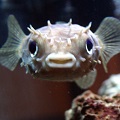
This fish was sold as having been collected in the Philippines.
Part 1. Care
This section describes our findings and practices with this fish, which are not necessarily the best and do not yet include a lot of learning.
1.1 Acclimation
For acclimation a modified version of the Diver's Den (Doctors Foster and Smith) bag-floating-in-tank progressive dilution approach was used. The first modification was to dump out 50% of the shipping water from the shipping bag before beginning of the process. This was possible because of the very generous bag volumes used by this fish seller and because the fish did not appear to be in respiratory distress. Second, the bag water volume was estimated and a single dose of Prime was added to reduce ammonia levels during acclimation. The bag water temperature was adjusted for 15 minutes as normal, then half sized (1/4 cup) additions of tank water began at timed 5-minute intervals. On four occasions the bag became filled and half the bag water was removed. Each time this was done the size of the additions was doubled to roughly maintain a constant dilution rate. Finally, to avoid netting, water was removed from the bag leaving the fish with enough to remain submerged and the bag was slipped under the water allowing the fish to escape. To minimize bag water in the tank the bag was lifted out and filled with tank water in one motion. The fish appeared healthy and showed little signs of distress.
1.2 Initial Eating
This OB was eating energetically the day after he was acclimated. We use a small brine shrimp net with a fine mesh to net out debris. Whenever this net was placed in the water he rushed over with the apparent expectation of food. He was target trained, smart fish. Within two days he was taking frozen krill from our hands at the tank surface. He also took great interest whenever hands were placed in the tank seeming to have the expectation that food was coming.
1.3 Accepted and Rejected Foods
Accepted Foods include:
* San Francisco Bay Frozen Krill
* Hikari Frozen clams on the half shell
* Hikari Sinking Carnivore Pellets (placed on empty clam shells)
* Hikari Sinking Massivore Pellets (placed on empty clam shells)
* Chopped Frozen Clam (type sold for making chowder)
* Frozen Shrimp (Type sold for human consumption)
* Live Fiddler Crab
* Live Littleneck Clam from grocery store (see note)
* Frozen Krill Soaked 5 minutes in Matonidezole (sometimes)
* Nightcrawler (half)
* Octopus -frozen seafood mix sold at the grocery store.
* 1-1/4 inch Domino Damselfish (they were good friends for 2 months, but we told him it was OK)
Note: We think the Littleneck clam should have been placed in salt water and allowed to open and clean itself out before feeding. Our failure to do so may have made him sick. He became lethargic for a few days and for two days his feces were "puddles" of yellow left on the tank bottom. When netted out these puddles seemed to be held together with strings of slime. We believe that the cause for this was most likely a Metronidazole susceptible internal parasite, as it recurred and appeared to respond to treatment with this medication. More on this below.
Rejected Foods
Frozen Brine Shrimp (apparently too small to be of interest)
Live 1" Domino Damsel (temporary cleanup crew). XXXX Strike this one he ate the Damsel.
Frozen Silversides (watched but never tasted)
Frozen Krill Soaked 15 minutes in Matonidezole (chewed up and spat out)
1.3 Temperature
We began by maintaining water temperature at 76F, but because this species is associated with India-Pacific reefs we suspect his ideal water temperature may be be at the high end of the often quoted temperature range for marine fish, 72-78F.
1.4 Illness and Medications
1.4.1 Treatment for Internal Parasites
We normally us a prophylactic treatment for internal parasites with our puffers, both fresh and salt water. Before we began a prophylactic treatment with this OB his feces changed to become thick "puddles" of uniform color (yellow to brown) containing strings of slime. He also became lethargic, less responsive to motions that would normally cause him to watch moving his eyes. He began hiding most of the time and food had to be delivered directly in front of him or he would not eat it. Suspecting internal parasites we began simultaneous treatment with Metronidizole fed orally and a Praziquantel bath as described below.
1.4.1.1 Metronidizole Fed Orally: The Metronidizole was administered orally in frozen krill thawed then soaked for 15 minutes in a solution of 100mg to two fluid ounces water (1 TBS). To assure the krill contained the mediation they were squeezed with tweezers several time while soaking. This was administered on 3 consecutive days. OB obviously did not like the taste of the Metronidizole. The first two days we found that the first two treated krill would be quickly eaten whole but the third was chewed, spat out, and subsequently refused.
We switched to feeding in Hikari Massivore pellets soaked for 10 minutes. tThis was taken more readily. It may be that spitting out the medication occurs when the undissolved crystals are encountered. This medication is not readily water soluble, so the water use to make the solution was quite warm. Thus also resulted in the pellets expanding more rapidly in the solution. Fed one soaked pellet per day.
1.4.1.2 Praziquantel Bath: We turned off the protein skimmer and UV and added a single dose of Praziquantel to tank water for a 5-day bath.
Praziquantel is often fed orally to puffers, but we opted for a water bath because Praziquantel is said to be more toxic to fish than Metronidizole with a greater potential for accidental overdose. Unlike many other medications, Praziquantel is known not to be harmful to filter bacteria, so a FOWLR aquarium can be treated very safely with a Praziquantel bath, so long as there are not a lot of susceptible live organisms in the rock or sand to die off and pollute the water. The live rock in the tank with OB was not populated with polys, algae, inverts, or much of anything else.
Praziquantel Notes: This science may not be right, so someone please let me know if the following is wrong. My understanding is that baths are not an effective way to administer Praziquantle into the digestive system of fresh water fish because their salinity is higher than their environment. Fresh water fish therefore take on water through their body membranes and only incidentally take water into their digestive systems orally. On the other hand, salt water fish are internally about 1/3 the salinity of seawater and therefore lose water through body membranes by osmosis. They must therefore take water in orally and expend considerable energy to transport water through their digestive system tissues to replace what is lost externally. As a result, Praziquantel can be administered to salt water fish digestive tracts in a bath, where freshwater treatments will be ineffective.
1.4.1.3 Treatment Outcome
The second day of treatment, what looked like a possible dead worm was seen stuck to the gravel on one end with the other end moving freely in response to tank currents. The appearance was that of a completely transparent 2cm long smooth uniform tube with an approximate diameter of 1-2mm. To the naked eye it had no noticeable segments, head, tail, or other noticeable features. It was gone before it could be suctioned out for microscopic examination.
After the 3 days Metronidazole treatment the fish became more sociable, hovered more rather than sitting on the bottom, and began venturing further from his hiding cave. Treatment was thought to have been successful, but bottom sitting and hiding increased over the next week and a half. Treatment was resumed and after four days very much more pronounced energy and activity levels were observed and the fish started acting eager and energetic but still sleeping during the day. Again he began hiding and bottom sitting within a week or so.
Reading about this medication human oral treatment is used for 10 days because bacteria affected are not completely killed with shorter treatment. We doubled the dose to two Metro-soaked Massivore pellets per day (in case bacteria we gaining immunity) and began treatment a third time.
Part 2. Behaviors
This section includes observations about this OB's behavior.
2.1 Anchoring for Rest
Two behaviors are used individually or together when this OB anchors himself against the current for rest.
2.1.1 Gill Pumping for Propulsion.
To scoot into a tight location without using the pectoral or tail fin, this OB often forces jets of water from its gills 3-4 times to move forward an inch or so. Prior to understanding this behavior we were concerned that it might indicate respiratory stress.
2.1.2 Inflation Use for Anchoring
Once this OB has pushed himself forward against a solid surface using gill pumping, he inflates his abdomen slightly to anchor the rear spines to stabilize the opposite end. The anchoring spine(s) may press against a rock, but anchoring spines into the sand substrate is just as common.
2.2 Behaviors While at Rest
While at rest this OB appears to respond to non-contact threats by imitating algae, sponges, debris, or other matter that would not be of interest to a carnivorous predator. The overall effect makes him easy to overlook; even gill movements are stopped. Initially there were occasions when we mistakenly though he might have died as we could see no indications of life.
2.2.1 Positioning and Movements While at Rest
While at rest, the caudal and adipose fins are gathered and the caudal fin is held in an upright position, sometimes with a slight curl to one side or the other. Other fins are relaxed and in neutral positions. All fins and are allowed to sway with the moving water current. While at rest during the day this fish seems to become, at times, very unresponsive to movements his eyes normally would follow and his normal color grows darker and is overlaid with dark gray.
2.2.2 Reduced Respiration
While in a resting position, gill movements slow to about one per 3 seconds and respiration may even be suspended, seemingly as a way to avoid detection.
2.2.2.1 Respiration on One Side
When we move in close for a good look at him his gill movements on the visible side often stop completely.
2.2.2.1 Suspected Suspended Respiration
At times when there are activities outside the tank very near this OB while at rest, he seams to completely suspend respiration for up to 10-15 seconds. We believe he is suspending respiration because, unlike respiration on only one side, the suspended movement of the visible gill is followed by a few seconds of increased respiration (e.g. 1/second). Our inability to view both gills at once makes this observation a bit tentative.
2.2.3 Minimized Eye Movements
While resting, eye movements often don't track motion of nearby objects that would normally catch his interest and be watched. Even at these times he will occasionally re-target his eyes to a new location, then remain motionless. At times this OB's eye movements may not respond to any activity near or around the tank (asleep?).
2.2.3.1 Putting food near him while he is at rest virtually always results in looking at the food even if he otherwise remains motionless.
2.2.4 Bright Lights Introduced While At Rest
This OB looks downward away from light for 10-15 minutes after room or tank light levels are significantly increased. He usually remains very unresponsive to visual stimuli during this time.
2.3 Feeding/Activity Times
This fish "sleeps" most of the day and becomes most active late in the evening. He may be out and about in the dark, but we don't have enough illumination to tell for sure.
2.3 Appearance
This OB dramatically changes color and pattern the brightness and contrast of his coloration. The base color is a medium brown with dark blotches and black dots, but the base color can be anything from pure white to dark brown and can include blue-, purple- or red-ish shades of beige and brown coloration.
2.3.1 Pattern
The surface pattern can also change to be overlaid with a darker pattern of speckling that is sometimes completely absent. The overall effect allows him to reduce visibility against a wide variety of backgrounds. For example, the contrast of his coloration increased to the point that he had pure white patches after a white shell was placed on the substrate under one eye. In the photos note that there are three patterns that are always present to some degree, by vary somewhat independently:
- a speckled pattern - most obvious in photos 4,5, and 7
- a blotched (porcupine puffer-esque) pattern that is always present but most prevalent in photo 6 and least in photo 1
- a pattern with dark purple grapes and yellow to yellow-orange circles around spine bases. Note how in photo 2 and three these circles are small and in photo 7 they are on more of the spines and much wider.
At times he is almost a solid light grey-tan with purple tint on the back half like photo 1) and at other times his color is quite dark, usually when sleeping. His iris color also changes.
The first 2 pictures are from December so you can see that he has filled out quite a bit.
Photo 1
Photo 2
Photo 3
Photo 4
Photo 5
Photo 6
Photo 7


